
The Long Road from Blues to Hip-Hop: How African American Music Shaped Every Corner of American Culture
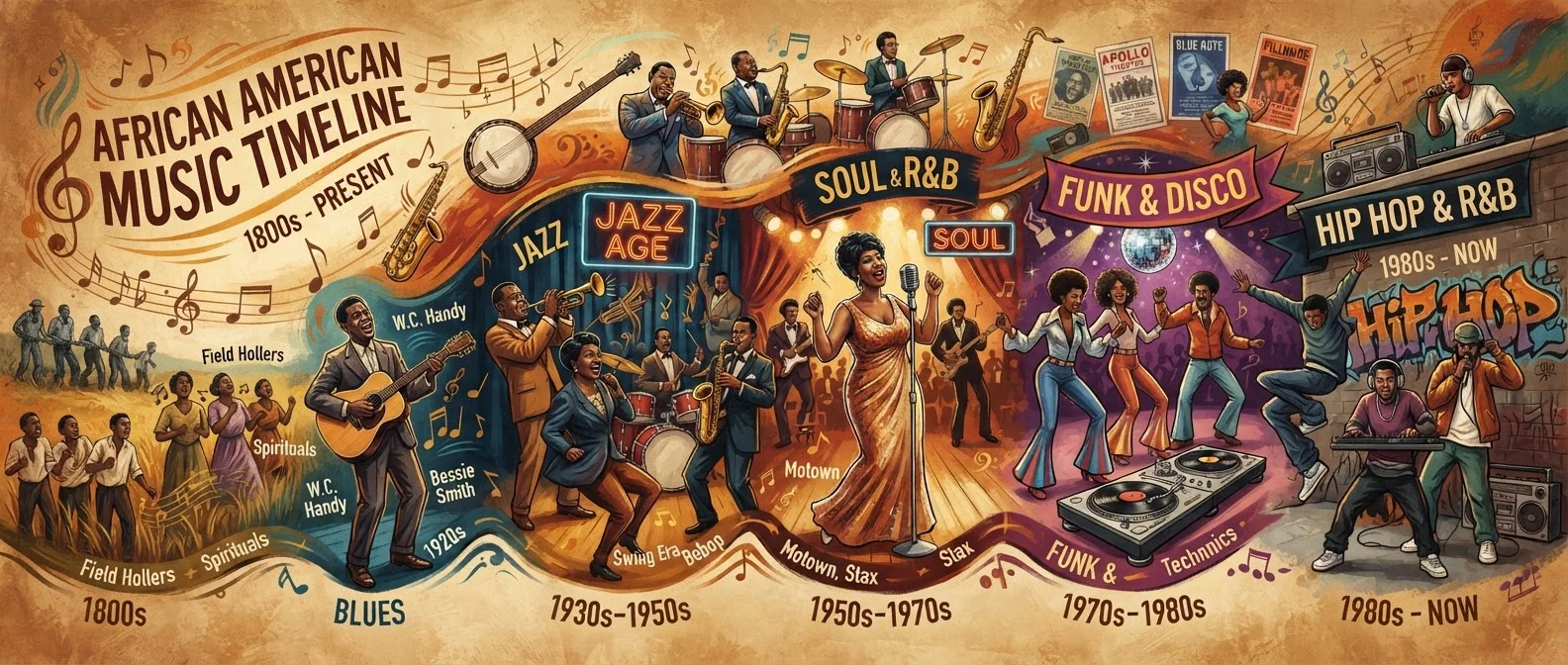
Photo credit: TrendingExperts.net
In this article
Trace the throughline from Delta blues and jazz to soul, funk, and hip-hop — and why each era transformed American life far beyond the charts.
Key Takeaways
- The blues, born in the Mississippi Delta, is the root system from which virtually all modern American popular music grew.
- Each genre shift - jazz, R&B, soul, funk, hip-hop - responded directly to the social conditions African Americans faced in that era.
- African American musical innovations have repeatedly been adopted into the mainstream, often while the originators faced systemic barriers.
- Hip-hop is not a cultural endpoint but the latest chapter in a centuries-long tradition of sonic creativity and resistance.
- Understanding this lineage deepens the experience of listening to almost any American popular music made today.
Where It All Begins: The Blues Foundation
If you want to trace American popular music back to its roots, you end up standing in the Mississippi Delta sometime around the late 19th and early 20th century. The blues emerged from the labor songs, field hollers, and spirituals of African Americans living under conditions of profound hardship - and it carried all of that emotional weight directly into its sound. A bent guitar string, a wailing vocal phrase, a lyric that holds grief and humor in the same breath: these are not stylistic accidents. They are a community's way of testifying.
The 12-bar blues structure - a chord progression so sturdy that genres have been built and rebuilt on top of it for over a century - became the skeleton of American popular music. Charley Patton, Robert Johnson, and Bessie Smith weren't just making regional folk art; they were laying architectural blueprints that rock and roll, country, jazz, and R&B would all draw from. The blues also carried its geography with it. Regional sounds like those from the Delta and the South remain audible in genres that seem entirely removed from their origins.
6 of 10
Top-charting American genres rooted in Black music traditions
Music historians and ethnomusicologists broadly document that the majority of dominant American popular genres - rock, pop, R&B, hip-hop, jazz, country - trace structural roots to African American musical innovations.
1.6M+
African Americans who relocated north during the Great Migration
The Great Migration (1910-1970) brought Black culture, including musical traditions, to Northern cities, accelerating the spread and commercialization of blues and jazz across the U.S.
#1
Hip-hop's rank as the most-streamed genre globally
Multiple streaming platform reports from the early 2020s have identified hip-hop/R&B as the most-consumed genre worldwide, a position consolidated over more than a decade.
Jazz, the Great Migration, and a Nation Transformed
When African Americans began moving north in large numbers during the Great Migration - roughly 1910 to 1970 - they brought their music with them, and cities like Chicago, New York, and Detroit were never the same. Jazz synthesized blues tonality with European harmonic structure and West African rhythmic complexity into something radically new. It was also radically improvisational: a form that celebrated individual expression within a collective framework, which itself carries social meaning worth thinking about.
By the 1920s and 1930s, jazz was the popular music of America - played in ballrooms, broadcast on radio, and debated in newspapers. Louis Armstrong, Duke Ellington, and Billie Holiday weren't just musicians; they were cultural architects reshaping how Americans understood sophistication, freedom, and grief. If you're curious about entering that world today, our guide to getting into jazz without getting lost offers a practical starting point.
When exploring early jazz or blues recordings, resist the urge to start with greatest-hits compilations - instead, try listening to a single artist's arc across a decade. The evolution within one career often tells the whole cultural story.
Contextual listening builds comprehension of how social conditions shaped artistic choices, making the music more meaningful rather than reducing it to isolated tracks.
Pay attention to the rhythm section, not just the melody or lyrics. In African American music traditions, the groove itself carries cultural meaning - the way a drummer lays back on the beat or a bassist locks with a kick drum is its own form of communication.
Many listeners trained on European-rooted classical or folk traditions focus on melody and harmony; understanding the rhythmic sophistication of Black music traditions opens up an entirely different level of appreciation.
Rhythm & Blues, Soul, and the Sound of Struggle
By the late 1940s, a harder-driving, electrified sound was emerging from Black urban communities - rhythm and blues, or R&B. Artists like Ray Charles and Ruth Brown were blending blues structures with gospel fervor and a new rhythmic urgency. By the 1950s, white teenagers were listening - and the music industry scrambled to create "cover" versions performed by white artists, a practice that documented in sharp relief how systemic racial inequality shaped the commercial music landscape.
Soul music, which peaked in the 1960s, went even further. It was the sound of the Civil Rights Movement without being explicitly political - Sam Cooke's "A Change Is Gonna Come," Aretha Franklin's command of a room, Marvin Gaye's later concept albums confronting war and environmental destruction. Soul communicated, as musicologist Mark Anthony Neal and others have argued, that Black life had dignity and depth that demanded acknowledgment. Music as identity was never more explicit than in this era.
Funk and Disco: Bodies on the Dance Floor, Politics in the Groove
James Brown's mid-1960s pivot toward an aggressively rhythmic, groove-locked sound essentially invented funk - a genre that put the emphasis squarely on the one beat and made the body respond before the brain caught up. Parliament-Funkadelic expanded funk into something cosmic and conceptual, while Sly & the Family Stone introduced multiracial collaboration as a political statement wrapped in an irresistible groove.
Disco, which dominated the late 1970s, drew directly from funk, soul, and Philadelphia soul orchestration. It was also the sound of marginalized communities - Black, Latino, and LGBTQ+ clubgoers - claiming pleasure and visibility in spaces that were briefly their own. The backlash against disco (culminating in events like the 1979 Disco Demolition Night in Chicago) reflected cultural anxieties that went well beyond musical taste.
Hip-Hop: From the Bronx to the World
Hip-hop's emergence in the South Bronx around 1973 is one of the most documented and most misunderstood origin stories in American music. DJ Kool Herc's isolation of the breakbeat - the percussive section of a funk or soul record - gave birth to a form built from existing recordings, creating something entirely new from inherited materials. That act of creative recycling is itself a continuation of the blues tradition: making art from what's at hand, within conditions of scarcity.
The four elements of hip-hop - DJing, MCing, breakdancing, and graffiti art - were always a holistic cultural movement, not just a music genre. By the late 1980s and 1990s, artists like Public Enemy, N.W.A, and Lauryn Hill were using the form to document, critique, and reckon with Black American experience in ways that demanded a hearing from the entire culture. For a closer look at how hip-hop's early story has been distorted over time, see our piece on the myths surrounding hip-hop's origins.
The Throughline: Why This Legacy Matters Now
Every major moment in this story follows a recognizable pattern: African American artists invent a new sonic language in response to specific social conditions; that language spreads outward and is absorbed - sometimes credited, sometimes not - into the broader American mainstream; and then the cycle begins again with a new generation finding a new form. Rock and roll came from blues and R&B. Pop's vocal production owes a profound debt to gospel and soul. Electronic dance music traces directly back to disco and funk. There is no American popular music without this lineage.
What's remarkable is that this tradition continues generating new forms rather than exhausting itself. Contemporary artists working in Afrobeats, trap, neo-soul, and hybrid genres are extending the same creative inheritance - and, as our look at genres crossing borders explores, the exchange is now genuinely global. Understanding where American music comes from doesn't just enrich how you listen - it transforms what you hear.

Author
Entertainment Editorial Team
Entertainment Editorial Team is the collective byline for our editorial team and contributor network. Articles published under this byline or an editorial pen name are researched, written, and reviewed according to our editorial standards for clarity, consistency, and independence before publication.
View all articles →