
The Psychology Behind Sale Prices: Why 'Limited Time' Feels Urgent
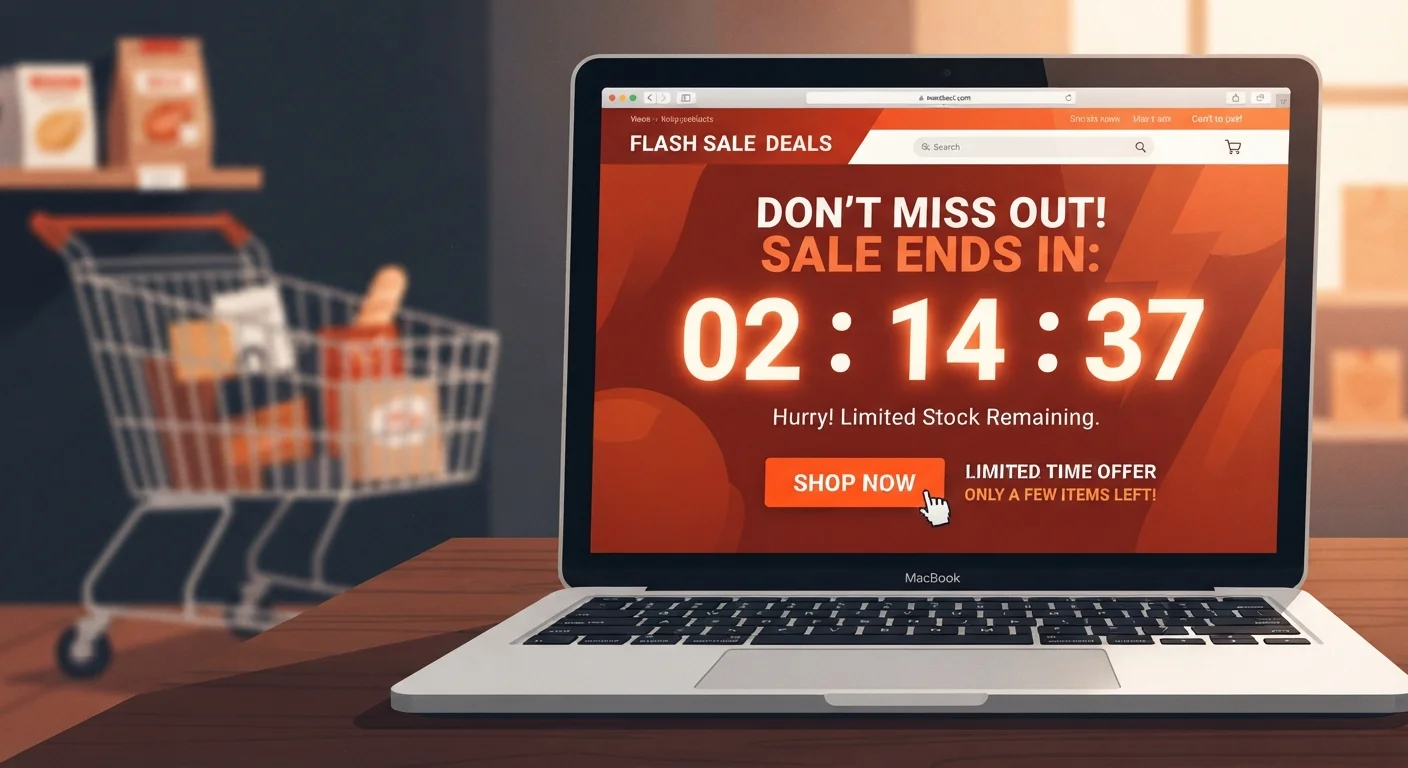
Photo credit: TrendingExperts.net
In this article
Retailers use urgency triggers to push fast decisions. Learn the mental shortcuts they exploit and how to shop with a clearer head.
Key Takeaways
- Urgency cues like countdown timers activate emotional responses that can override rational evaluation.
- Many 'limited time' promotions recur regularly - the deadline is often artificial.
- Scarcity claims ('only 2 left in stock') are not always verified and can be inflated.
- Slowing down before purchasing is one of the most effective tools against urgency tactics.
- Genuine deals don't require panic - verifiable value holds up under deliberate scrutiny.
How Urgency Hijacks the Decision Process
The human brain processes threats and opportunities differently depending on perceived time. When something appears to be expiring - a sale, a stock level, a price - the brain shifts toward fast, emotionally driven decision-making rather than slower, analytical thinking. Retailers have studied this dynamic carefully and design their promotions to trigger it deliberately.
Countdown clocks are among the most visible tools. A ticking timer shifts attention away from questions like Do I actually need this? and toward Will I lose this chance? That shift is not accidental. It mimics the cognitive load of genuine scarcity - the evolutionary signal that resources are running out - even when the underlying situation is entirely manufactured.
This is why recognizing urgency as a design choice, rather than a neutral signal, is the first step toward clearer shopping decisions. The feeling of urgency is real; what's less certain is whether the deadline itself is.
“Consumers don't respond to prices in isolation - they respond to the story retailers tell around the price. Urgency is a narrative device as much as a commercial one.”
— Richard Thaler, Nobel Prize-winning behavioral economist and author of Nudge
The Most Common Urgency Tactics in Retail
Urgency triggers appear across both physical and online retail environments. Understanding the mechanics behind each helps consumers respond with intention rather than reflex.
- Countdown timers: Often displayed on e-commerce pages or in promotional emails, these create a visual deadline. Many reset automatically or apply to promotions that repeat frequently.
- Low-stock alerts: Messages like 'Only 4 left!' can be dynamically generated and may not reflect actual inventory. They anchor attention on loss rather than value.
- Flash sales: Short windows for specific discounts create FOMO and compress the time available for comparison shopping. The same item may be available at a similar or lower price elsewhere.
- Exclusive access framing: Language suggesting a deal is available only to you - 'Your personal offer expires tonight' - personalizes the urgency, making it feel higher-stakes.
These tactics often work in combination. A flash sale with a low-stock alert and a personalized email creates layered pressure that compounds the emotional response. See how these techniques relate to retail pricing tricks that inflate markdowns for a fuller picture of how urgency and anchor pricing often work together.
Pause Before You Click 'Buy Now'
When you notice a countdown clock, low-stock alert, or 'today only' label, treat it as a prompt to slow down rather than speed up. Ask yourself: Would I still want this item tomorrow if the price were the same but the timer were gone? That single question can interrupt urgency-driven momentum and shift you back to evaluating the purchase on its actual merits.
Why the 'Deal' Frame Matters as Much as the Price
Urgency is rarely presented in isolation - it is almost always paired with the framing that something valuable is at stake. Retailers don't just say a price is expiring; they position the expiring price as a rare opportunity to save. This framing matters psychologically because it redefines the cost of inaction: not buying feels like losing money, rather than simply not spending it.
Behavioral researchers call this loss aversion - the well-documented tendency to feel losses more sharply than equivalent gains. A $40 discount 'about to disappear' feels more motivating than the neutral fact of a $40 price difference. Retailers engineer their messaging to activate exactly this asymmetry.
This is also why deal fatigue is a real risk: exposure to constant 'loss framing' through promotional messaging gradually erodes the cognitive energy needed to evaluate each offer carefully, increasing the likelihood of impulsive decisions.
~90%
Consumers influenced by scarcity messaging
Consumer psychology research consistently finds that scarcity and urgency cues measurably increase purchase intent across a broad majority of shoppers, regardless of income or shopping experience.
24 hrs
Waiting period that reduces impulse purchases
Consumer behavior studies suggest that a self-imposed 24-hour delay before non-essential purchases significantly reduces regretted or impulsive buying decisions.
2-3×
Loss aversion effect vs. equivalent gain
Behavioral economics research, including foundational work by Kahneman and Tversky, demonstrates that people feel losses roughly two to three times more strongly than equivalent gains - the basis for loss-framing in promotions.
How to Shop More Deliberately Under Pressure
Awareness alone reduces the impact of urgency tactics, but practical habits reinforce it. A few concrete approaches help consumers reclaim deliberate decision-making even when retailers are working against it.
- Apply a waiting period. For non-essential purchases, a self-imposed 24-hour pause interrupts the emotional momentum created by urgency cues. If the deal is still available - or returns, as many do - it validates that the deadline was not real. If it's gone and you don't miss it, that's informative too.
- Separate the discount from the value question. Ask whether you would buy the item at the sale price if there were no countdown clock and no 'original' price shown. If the answer is no, the urgency - not the item's value - is doing the work.
- Track price history where possible. Browser extensions and third-party tools can display historical price data for many online products, allowing you to assess whether a 'sale price' is actually lower than the norm. Seasonal pricing patterns also follow predictable rhythms that, once understood, make it easier to anticipate when prices genuinely dip.
- Watch for downstream costs. A sale price that triggers free shipping thresholds, bundle upsells, or add-on offers can quietly erode its own value. Cart totals that grow after a 'great deal' are a common pattern worth understanding before checkout.
None of these steps require significant effort - they just require a brief interruption of the urgency-driven momentum retailers count on.
Frequently Asked Questions

Author
Shopping Editorial Team
Shopping Editorial Team is the collective byline for our editorial team and contributor network. Articles published under this byline or an editorial pen name are researched, written, and reviewed according to our editorial standards for clarity, consistency, and independence before publication.
View all articles →