
Why "Anyone Can Make Art" Is Both True and Complicated
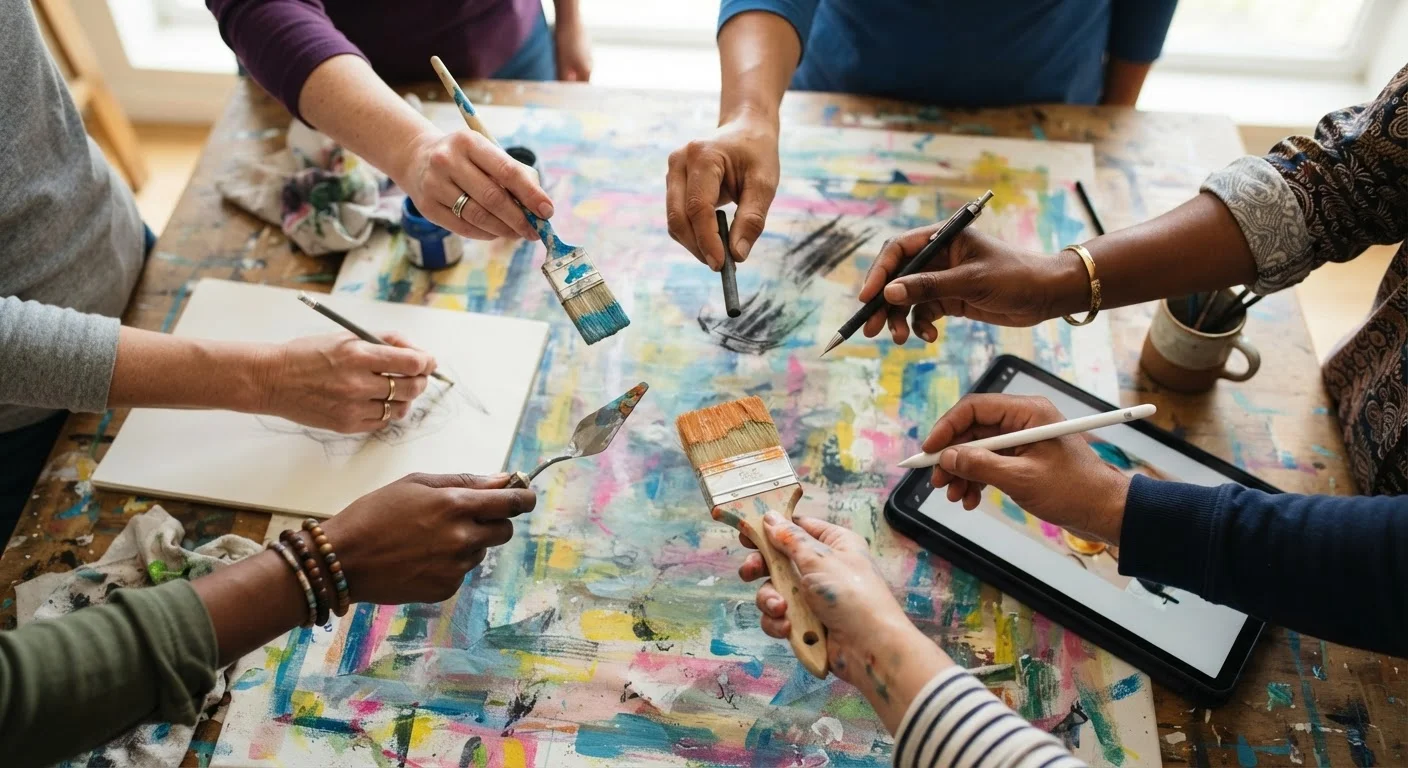
Photo credit: TrendingExperts.net
Is artistic ability innate or learned? We unpack common myths about talent, creativity, and who gets to call themselves an artist.
Key Takeaways
- Artistic talent is not purely innate - deliberate practice plays a significant, research-supported role in skill development.
- The idea that only 'gifted' people are real artists is a cultural myth, not a biological fact.
- Creativity and technical skill are separate things; you can build both independently over time.
- Anyone can make art, but access to training, materials, and encouragement is not equally distributed.
- Calling yourself an artist is a matter of practice and intention, not gatekeeping credentials.
The Inspiring Claim - and Its Hidden Tensions
"Anyone can make art" has become something of a rallying cry - posted on studio walls, shared in art-class syllabi, and championed by creative communities online. And it carries real truth. Human beings have been making images, objects, and sounds for at least 45,000 years, long before formal training existed. The impulse to create is genuinely universal.
But the phrase also papers over some complicated realities: unequal access to materials and instruction, deeply ingrained beliefs about who counts as a "real" artist, and the very real difference between making art and making art well. Understanding those tensions - rather than dismissing them - is what actually makes the statement empowering rather than hollow.
Whether you're picking up a sketchbook for the first time or wondering whether your weekend pottery hobby "counts," the myths below are worth examining. And if you want to go deeper into how art works visually, reading a painting step by step is a great next stop.
Myth
You either have artistic talent or you don't - it's something you're born with.
Fact
Artistic skill is largely developed through practice, not delivered at birth as a fixed gift.
The "born with it" narrative is compelling but misleading. Psychologist Anders Ericsson's decades of research on expertise - summarized in his book Peak - found that deliberate, structured practice is the primary driver of high-level skill across domains, including music and visual arts. Early exposure, consistent feedback, and motivated repetition matter far more than any innate endowment. Some people may have early advantages in spatial reasoning or fine motor control, but those are starting points, not ceilings.
Myth
If you can't draw realistically, you aren't a real artist.
Fact
Realistic drawing is one technique among many - it has never been the universal standard for artistic legitimacy.
This myth ignores enormous swaths of art history. Abstract Expressionism, Cubism, folk art, outsider art, and digital generative art all operate outside photorealistic representation. Pablo Picasso could draw with academic precision but deliberately moved away from it. Henri Matisse famously said his simplified forms required as much discipline as realism. Technical drawing skill is a valuable tool, not a gatekeeper credential.
Myth
Creativity is a fixed trait - some people are creative and some simply aren't.
Fact
Creativity is a cognitive process that can be practiced and expanded, not a static personal characteristic.
Research in cognitive psychology consistently treats creativity as a skill set involving associative thinking, curiosity, and tolerance for ambiguity - all of which respond to practice and environment. Studies published in journals like Psychology of Aesthetics, Creativity, and the Arts suggest that creative output increases when people engage regularly with creative tasks and are given psychological safety to experiment without judgment. Calling someone "not a creative person" is more a cultural label than a neurological verdict.
Myth
Anyone can make good art - effort alone is enough.
Fact
Effort is necessary but not sufficient; feedback, instruction, and time all shape how skills develop.
This is where the inspiring version of the slogan oversimplifies. Making art is accessible to everyone; making art that achieves what you intend requires learning - whether self-directed, through community, or via formal instruction. Without some form of informed feedback, practice can reinforce habits rather than correct them. That's not a reason to be discouraged; it's a reason to seek out resources, communities, and honest responses to your work. Growth requires more than hours logged.
Myth
Only formally trained artists have the right to call themselves artists.
Fact
Artistic identity is claimed through practice and intention, not conferred by institutions.
Art history is rich with self-taught figures - Jean-Michel Basquiat, Grandma Moses, and Henry Darger among them - whose work achieved critical and cultural recognition without formal degrees. Meanwhile, many MFA graduates never practice art professionally after graduating. What makes someone an artist is sustained engagement with making, not a certificate. That said, formal training does offer structure and feedback that accelerate development - it's a resource, not a requirement.
What the Myths Get Wrong - and Right
The myths above share a common thread: they treat art as an exclusive club with a fixed membership list. In reality, artistic identity is far more fluid. Art history is full of self-taught practitioners - folk artists, outsider artists, and late-starters - whose work now hangs in major institutions.
45,000+
Years humans have been making art
Cave paintings found in Sulawesi, Indonesia, dated using uranium-series analysis, are among the oldest known figurative artworks, per research published in the journal Nature (2019).
~10 years
Typical deliberate practice to reach expert-level skill
Anders Ericsson's research on expertise, widely cited in cognitive psychology, found roughly a decade of deliberate practice distinguishes novices from top performers across creative fields.
54 million
Americans who participate in visual arts
According to the National Endowment for the Arts' Survey of Public Participation in the Arts, tens of millions of Americans engage in visual arts creation as part of their personal lives.
That said, "anyone can make art" should never become a reason to ignore the structural barriers that make access uneven. Quality art education, studio space, and materials cost money. Not everyone grows up in an environment that affirms creative ambition. Recognizing those gaps matters - not to discourage anyone, but to push for broader access rather than pretending the playing field is already level.
Curious about where art-making can lead beyond the hobby room? Weighing art as a hobby versus a career is worth reading before you make any big decisions. And if you're wondering how the creative world categorizes artistic work, the difference between fine art and commercial art offers helpful context. For a broader cultural grounding, art movements every curious person should know provides an approachable tour of the ideas that shaped contemporary creativity.
The bottom line: the statement is true in its spirit and complicated in its execution. That's not a reason to abandon it - it's a reason to take it seriously.

Author
Entertainment Editorial Team
Entertainment Editorial Team is the collective byline for our editorial team and contributor network. Articles published under this byline or an editorial pen name are researched, written, and reviewed according to our editorial standards for clarity, consistency, and independence before publication.
View all articles →