
Art Movements Every Curious Person Should Know
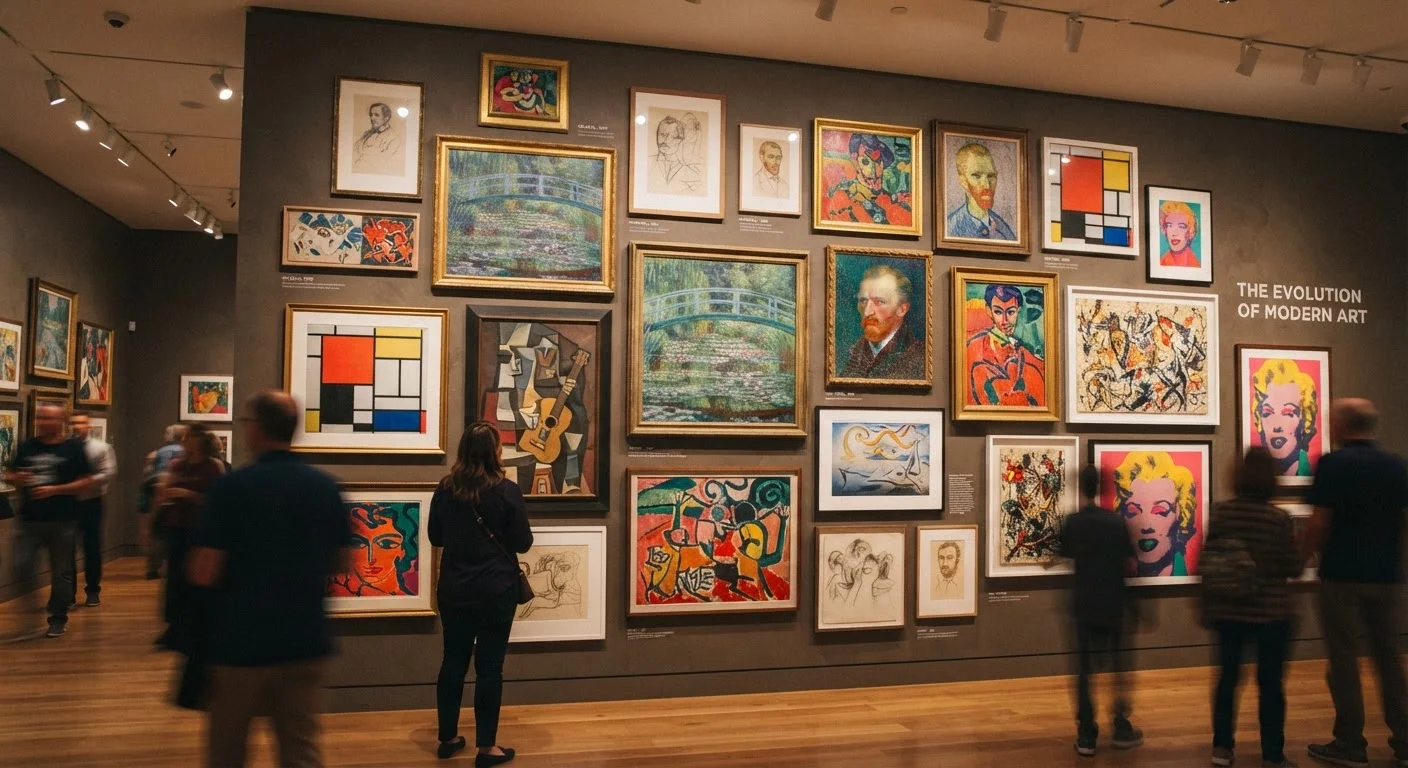
Photo credit: TrendingExperts.net
In this article
From Impressionism to Conceptualism, get a plain-language tour of the major art movements that shaped how we see the world today.
Why Art Movements Matter
Art history can feel like a mountain of unfamiliar names, dates, and isms. But strip away the jargon and what you find is something genuinely compelling: a record of how human beings have pushed back against the world around them - politically, emotionally, philosophically - through image-making. Art movements are simply groups of artists who shared a common vision at a particular moment in time.
Understanding even a handful of them changes how you experience museums, films, album covers, and city murals. It's the difference between glancing at something and actually seeing it. Our guide to reading a painting builds on exactly these foundations.
| Impressionism named by | A critic mocking Monet's 1872 painting (The term came from a satirical review in Le Charivari, 1874) |
| Cubism co-founders | Pablo Picasso & Georges Braque (Developed between approximately 1907-1914) |
| Abstract Expressionism hub | New York City, post-World War II (Shifted the global art center from Paris to New York) |
| Surrealism founding document | André Breton's Surrealist Manifesto, 1924 (Published in Paris, 1924) |
| Pop Art peak decade | 1960s (Flourished in the United States and United Kingdom) |
The Big Movements, Plain and Simple
Here's a fast tour of the movements that shaped modern visual culture - what they reacted against, what they stood for, and why they still resonate.
Impressionism (1860s-1880s)
Born in France, Impressionism broke from the polished, story-telling paintings that dominated official salons. Artists like Claude Monet and Berthe Morisot painted outdoors, capturing fleeting light and atmosphere rather than precise detail. Critics mocked the loose brushwork - the movement's name actually comes from a sarcastic review of Monet's Impression, Sunrise (1872). Today, Impressionist works are among the most beloved in the world.
Expressionism (early 1900s)
Where Impressionists recorded external light, Expressionists broadcast internal emotion. Distorted figures, electric colors, and raw brushwork were tools for conveying anxiety and alienation - themes that felt urgent in pre-war Europe. Edvard Munch's The Scream is perhaps the movement's most recognizable image.
Cubism (1907-1920s)
Pablo Picasso and Georges Braque shattered the idea that a painting must show one viewpoint at one moment. Cubism showed subjects from multiple angles simultaneously, flattening them into geometric fragments. It was disorienting on purpose - a direct challenge to centuries of perspective-based representation.
Surrealism (1920s-1940s)
Inspired by Freudian psychoanalysis and the chaos of World War I, Surrealists like Salvador Dalí and René Magritte mined dreams, the unconscious, and irrational juxtaposition for their imagery. Their work asked: what if logic isn't the whole story? Surrealism's visual DNA runs through everything from avant-garde cinema to modern advertising.
Abstract Expressionism (1940s-1950s)
Postwar New York became the center of art's universe when painters like Jackson Pollock and Mark Rothko rejected recognizable imagery entirely. Emotion, gesture, and scale were the point. Pollock's drip paintings weren't accidents - they were highly controlled explorations of process and physicality.
Pop Art (1950s-1960s)
Andy Warhol, Roy Lichtenstein, and their peers looked at consumer culture and supermarket shelves and declared: this is art too. Pop Art blurred the boundary between fine art and commercial imagery, raising questions about originality, mass production, and celebrity that feel even more relevant in the social media age.
Conceptualism (1960s-present)
Conceptual art made the idea the artwork. The physical object became secondary - sometimes nonexistent. Marcel Duchamp's earlier readymades (like a signed urinal exhibited as sculpture) were a direct ancestor. Conceptualism opened art to anyone with a strong enough idea, a claim explored in our piece on who gets to call themselves an artist.
Art Movement
A shared set of ideas, styles, or goals pursued by a group of artists during a particular period. Movements often arise as reactions to what came before them.
Avant-garde
French for 'advance guard.' Refers to artists and works that push beyond established boundaries, experimenting with new forms and ideas ahead of mainstream acceptance.
Readymade
An everyday manufactured object presented as a work of art with minimal or no alteration. Associated with Marcel Duchamp, it challenged assumptions about what art could be.
Abstraction
Art that does not attempt to represent external reality accurately. Instead, it uses shapes, colors, and forms to express ideas or emotions independently of recognizable subjects.
Conceptual Art
Art in which the idea or concept behind the work is considered more important than the finished object. The intellectual content takes priority over craft or aesthetics.
Salon (art)
An official exhibition organized by the French Academy of Fine Arts, historically the gatekeeper for artistic recognition in 18th- and 19th-century Europe.
How Movements Connect to Your World
These movements aren't locked in textbooks. Impressionist color theory influences oil painting and digital illustration alike. Cubist fragmentation echoes in graphic design and film editing. Surrealist imagery fills music videos. Pop Art sensibility saturates Instagram aesthetics.
Once you recognize these visual languages, you'll spot them constantly - in gallery shows, street murals, blockbuster movie posters, and product packaging. Art history isn't a closed archive. It's an ongoing conversation, and knowing the vocabulary means you're invited in.

Author
Entertainment Editorial Team
Entertainment Editorial Team is the collective byline for our editorial team and contributor network. Articles published under this byline or an editorial pen name are researched, written, and reviewed according to our editorial standards for clarity, consistency, and independence before publication.
View all articles →