
Speed Limits Are a Legal Ceiling, Not a Safety Target
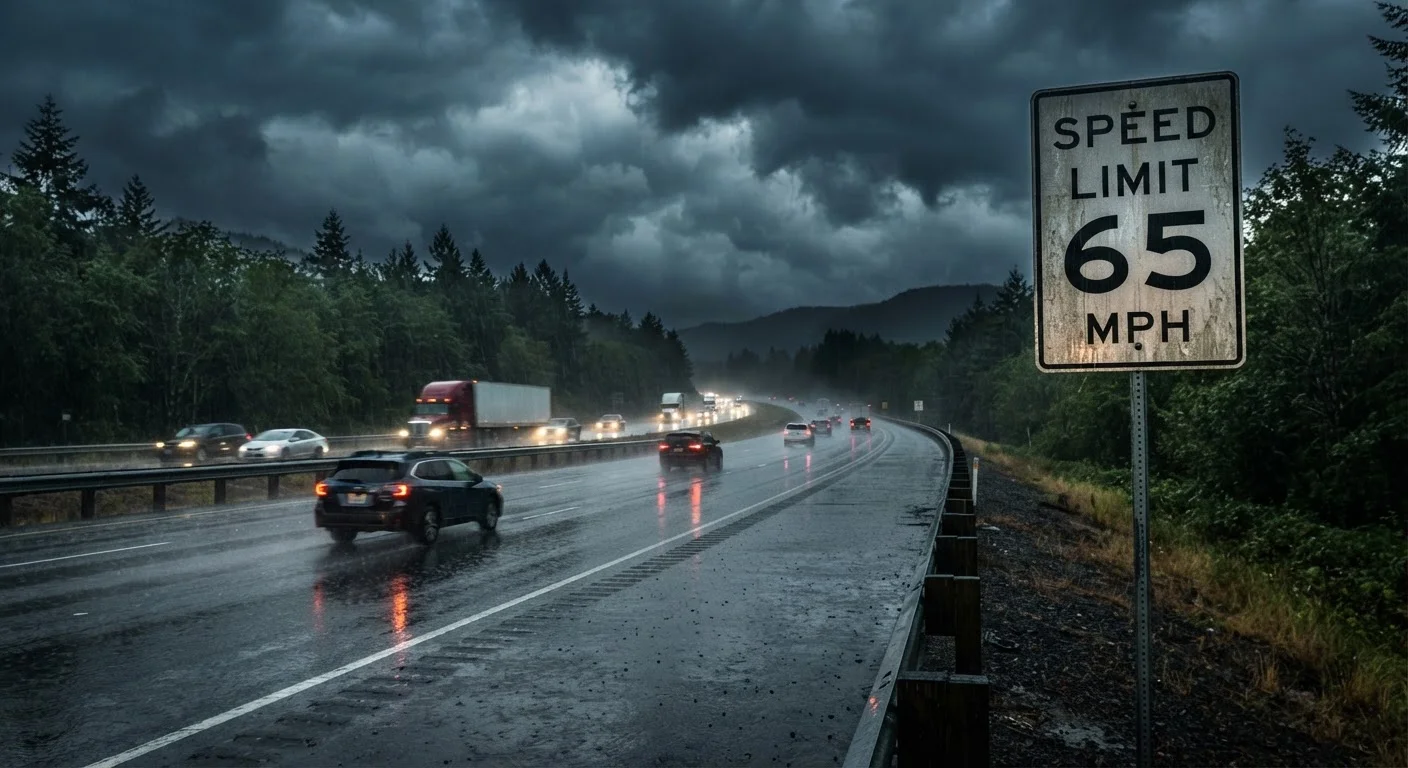
Photo credit: TrendingExperts.net
In this article
Posted limits reflect ideal conditions. Understand how road design, traffic flow, and weather change what speed is actually appropriate.
Key Takeaways
- Speed limits represent the maximum legal speed under ideal conditions, not a safe target for all situations.
- Weather, visibility, traffic density, and road geometry can all require driving well below the posted limit.
- Driving at the posted limit during hazardous conditions can still constitute reckless or negligent operation under law.
- Reaction distance and stopping distance increase significantly with speed - even small reductions matter.
- Adjusting speed to conditions is both a legal obligation and a fundamental safety practice in all U.S. states.
What Speed Limits Actually Represent
Speed limits are set through an engineering and policy process that typically considers road geometry, design standards, land use, and historical crash data. The number on the sign reflects the maximum legal speed a driver may travel - under favorable conditions. It is not an endorsement that that speed is safe at all times, and it was never intended to be.
Most statutory speed limits are established assuming dry pavement, good visibility, light traffic, and a driver who is alert and unimpaired. Strip away any one of those conditions and the appropriate safe speed drops - sometimes dramatically. Understanding this distinction changes how a driver should interpret every speed limit sign they pass.
29%
Of traffic fatalities involving speeding
According to the National Highway Traffic Safety Administration (NHTSA), speeding was a contributing factor in approximately 29% of all U.S. traffic fatalities in recent years.
4×
Kinetic energy increase from doubling speed
Because kinetic energy scales with the square of velocity, doubling your speed quadruples the energy that must be absorbed in a collision - a fundamental principle of crash physics.
316 ft
Typical stopping distance at 70 mph on dry pavement
At 70 mph, the combined perception-reaction and braking distance for an average vehicle on dry pavement can exceed 300 feet - longer than a football field.
Common Myths About Speed Limits, Corrected
Drivers carry a surprising number of misconceptions about what speed limits mean and how they interact with real driving conditions. Each of the following myths is widely held - and each one creates genuine risk on the road.
Myth
If I'm driving at the speed limit, I'm driving safely and can't be held responsible for an accident.
Fact
Compliance with the posted limit does not automatically equal safe or legally defensible driving. Basic speed laws in every state require drivers to adjust for actual conditions.
Speed limits define a legal maximum, not a safety guarantee. A driver who strikes another vehicle while traveling at exactly the limit in heavy fog or on black ice may still face civil liability or criminal charges if investigators determine conditions required a lower speed. The posted number is the starting point for legal travel - it is not a safe harbor that insulates a driver from responsibility.
Myth
Going with the flow of traffic is always the safest approach, even if traffic is speeding.
Fact
Matching the speed of surrounding traffic does not eliminate risk and does not make an unlawful speed legal or safe.
Traffic flow speed and appropriate speed are different things. On an open highway in ideal conditions, flowing with traffic can reduce certain risks related to speed differential. But when traffic is collectively traveling above the limit - or above what conditions safely allow - joining that flow compounds risk. It also provides no legal protection: officers routinely ticket multiple vehicles moving together above the limit. Each driver is individually responsible for their speed choice.
Myth
Speed limits are set conservatively, so there's always a comfortable buffer above them.
Fact
Limits are not uniformly conservative, and any buffer assumption is dangerous because it ignores the variable nature of actual road conditions.
Speed limits are set through engineering studies that vary considerably in methodology and age. Some limits do reflect conservative estimates; others reflect political compromise, outdated data, or were set before significant increases in vehicle and pedestrian traffic. Assuming a built-in safety buffer and routinely exceeding the limit removes the margin that engineers intended for unexpected events - a child stepping off a curb, a tire blowout, or a sudden stop by the car ahead.
Myth
Speed itself isn't dangerous - it's only dangerous driving that causes crashes.
Fact
Speed is a direct, measurable factor in crash severity. Higher speeds reduce reaction time and dramatically increase stopping distances and impact forces.
Physics does not negotiate. Kinetic energy increases with the square of velocity, meaning a vehicle traveling at 60 mph carries four times the energy of one at 30 mph - not twice. That energy must be absorbed in a crash. Pedestrian fatality risk rises steeply with impact speed: a pedestrian struck at 40 mph faces a far higher fatality probability than one struck at 20 mph. Speed is not a neutral variable - it is one of the most consequential factors in determining whether a crash is survivable.
Myth
On a clear day with little traffic, the speed limit is effectively just a suggestion.
Fact
Speed limits remain legally binding regardless of traffic volume or weather, and clear conditions still involve risks that limits are designed to manage.
Low traffic does not eliminate hazards - it can mask them. A deer entering the roadway, a pothole, an unexpected curve, or a vehicle merging from a side road can arise at any moment. The limit reflects the design parameters of the road itself, not just traffic density. Treating it as optional under favorable conditions builds habits that persist into unfavorable ones, which is where the consequences become severe.
Conditions That Demand Reduced Speed
Several factors routinely require speeds well below the posted limit, regardless of what the sign reads.
- Wet or icy pavement: Water reduces tire grip significantly. Ice can reduce it by 80% or more compared to dry asphalt. Stopping distances multiply accordingly. Our guide to driving in rain, snow, fog, and ice explains how to calibrate your speed for each condition.
- Reduced visibility: At night, in fog, or in heavy rain, your ability to see and react to hazards is compressed. If your headlights illuminate 200 feet ahead but you need 300 feet to stop at your current speed, you are overdriving your visibility. Night driving carries specific risks that posted limits do not account for.
- Heavy traffic: Following distance must expand as speed increases. In congested conditions, the posted limit may be physically unachievable safely - and attempting it is dangerous regardless of legality.
- Curves and grades: Speed limits on straightaways do not account for how a vehicle handles on sharp curves or steep descents. Advisory speed signs on curves exist precisely because the posted limit may be inappropriate there.
- Construction zones: Reduced lanes, uneven surfaces, workers present, and altered road geometry all increase hazard. Reduced limits in these zones are mandatory, and enforcement is typically heightened.
Overdriving Your Visibility Is a Recognized Hazard
Driving faster than your ability to see and react is called 'overdriving your headlights' at night, but the same principle applies in fog, rain, or smoke. If a hazard appears within your line of sight and you cannot stop before reaching it at your current speed, you are traveling too fast - regardless of what the sign says. Reduce speed until your stopping distance fits comfortably within your visible range.
The Legal Side: Basic Speed Laws
Every U.S. state has what is commonly called a "basic speed law" - a requirement that drivers travel at a speed that is reasonable and prudent given actual conditions, regardless of the posted limit. This means a driver traveling at exactly the speed limit in a blizzard can still be cited or found liable in a collision because conditions demanded slower travel.
New drivers especially benefit from understanding this principle early. Graduated licensing programs are structured in part because new drivers lack the experience to calibrate speed-to-conditions judgment - a skill that takes deliberate development over time.
Driving defensively means treating speed limits as a ceiling to stay under, while continuously asking what speed is genuinely appropriate for the conditions right in front of you. That question, asked honestly at every mile, is the actual foundation of safe driving.

Author
Automotive Editorial Team
Automotive Editorial Team is the collective byline for our editorial team and contributor network. Articles published under this byline or an editorial pen name are researched, written, and reviewed according to our editorial standards for clarity, consistency, and independence before publication.
View all articles →