
The Signals That Separate Genuine Customer Reviews from Fake Ones
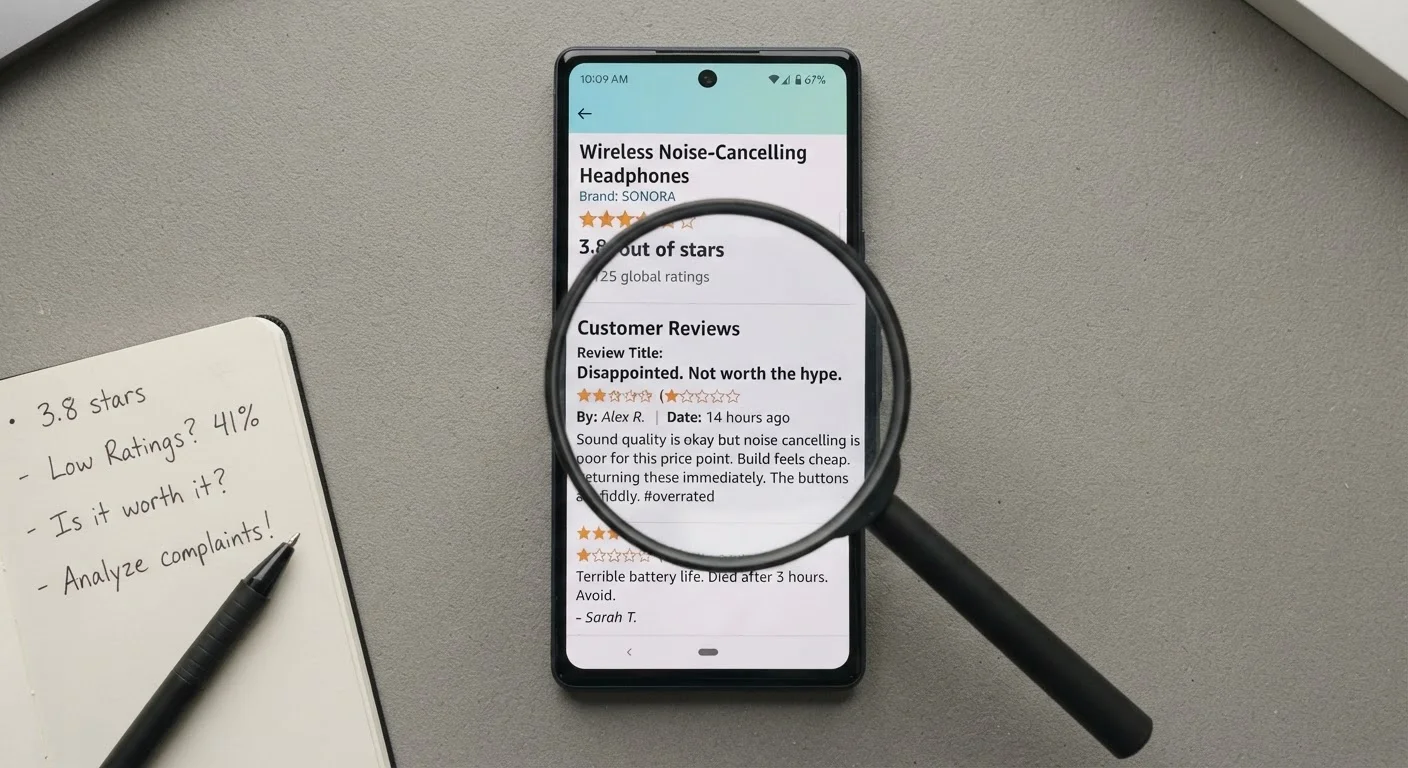
Photo credit: TrendingExperts.net
In this article
Fake reviews are widespread online. Learn the linguistic patterns, rating distributions, and red flags that can help you tell real feedback from manufactured praise.
Key Takeaways
- A product with hundreds of five-star reviews but no critical feedback is a statistical red flag worth investigating.
- Reviewers with no purchase history, no profile photo, and a single review are common hallmarks of fake accounts.
- Vague, emotion-heavy language that avoids specific product details is a reliable indicator of inauthentic content.
- Rating distribution shape-not just the average-reveals whether a review set looks organic or engineered.
- Third-party review analysis tools can help detect suspicious patterns that are invisible to the naked eye.
Why Fake Reviews Are Harder to Spot Than You Think
Most shoppers know fake reviews exist, but the assumption that they're easy to identify leads to a false sense of security. Modern review fraud has become sophisticated: operators use real-looking accounts, drip-feed submissions over time, and mix genuine reviews with paid ones to maintain plausibility. The result is that casual reading often isn't enough.
Understanding the mechanics behind fake reviews-who creates them, how they're distributed, and what linguistic fingerprints they leave-gives you a much stronger filter. Pair that knowledge with an understanding of how star rating distributions work and you'll have a more complete picture of any product's actual standing.
Myth
A product with a 4.8-star average and thousands of reviews must be genuinely excellent.
Fact
High averages on large review counts can reflect coordinated campaigns rather than authentic satisfaction.
Review manipulation often targets the aggregate score directly. Sellers can commission bulk positive reviews that push the average up while diluting the statistical weight of any critical feedback. A healthier signal is the shape of the distribution: authentic products typically show a spread that includes some three- and four-star reviews. A near-perfect curve where 95% of reviews are five stars and almost none are two or three is statistically unusual for any real product used by a diverse customer base.
Myth
Detailed, lengthy reviews are always more trustworthy than short ones.
Fact
Length alone is not a reliable authenticity indicator; some fake review operations specifically produce long, detailed-sounding content.
Paid review services have evolved. Many now provide templates or trained writers who produce reviews of 150-300 words with fabricated specifics. What matters more than length is whether the detail is verifiable and use-specific: references to a real-world context ("I use this in a drafty garage in winter"), comparisons to prior products the reviewer owned, or mentions of a product's shortcomings alongside its strengths. Generic enthusiasm, even when wordy, doesn't qualify.
Myth
The 'Verified Purchase' badge guarantees the review is genuine.
Fact
Verified Purchase status confirms a transaction occurred but cannot confirm the review wasn't incentivized or submitted by someone other than the buyer.
Some review manipulation schemes involve purchasing small quantities of a product through real buyer accounts specifically to earn the verified label before posting a paid review. Others involve sellers offering refunds after purchase in exchange for positive feedback-a practice that violates major platform policies but still occurs. Treat Verified Purchase as a mild positive signal, not a guarantee. It's one data point in a constellation, not a credential that overrides other red flags.
Myth
Negative reviews are always honest, so I should trust them more than positive ones.
Fact
Negative reviews can also be manipulated-competitors sometimes submit false critical reviews to undermine a rival product.
Just as sellers can buy positive reviews, bad actors can seed negative ones. Signs of inauthentic negative reviews include: extreme, one-dimensional language with no nuance; references to product features that don't actually exist; and reviewer profiles that post negative reviews across multiple competing products in the same category. Read critical reviews the same way you'd read positive ones-look for specificity, purchase context, and plausible use cases rather than assuming negativity equals honesty.
Myth
If a product is sold by a major, well-known retailer, its reviews are monitored and reliable.
Fact
Major platforms have known, persistent review integrity problems that their own published research and regulatory scrutiny have confirmed.
Regulators in the U.S. and internationally have taken action against major marketplaces for failing to adequately police fake reviews. Third-party sellers on large platforms operate with substantial autonomy, and the sheer volume of listings makes comprehensive review auditing difficult. Even when platforms remove fraudulent reviews, the process lags behind the pace of new submissions. Platform size is a trust signal for logistics and returns-not for review accuracy.
The Patterns That Actually Signal Authenticity
Genuine reviews tend to share structural traits: they're specific, mixed in sentiment, and grounded in personal use context. A reviewer who mentions that the zipper jammed after three weeks of daily commuting is giving you something verifiable and personal. One who writes "Amazing product!! Changed my life!! 5 stars!!" is giving you almost nothing useful.
Beyond individual review content, look at the reviewer's account history. Authentic consumers typically have a review trail spanning multiple categories and timeframes. A profile with 47 reviews all posted within one month, all five-star, all for electronics, warrants real skepticism. Similarly, check whether purchases are marked as verified-while this label isn't foolproof, its absence on a high-praise review raises the stakes for scrutiny.
The timing of review clusters is another underused signal. Organic reviews accumulate gradually. A product that receives 200 reviews in 48 hours following a quiet period almost certainly benefited from a coordinated campaign. Some browser extensions and third-party tools analyze this velocity data automatically and flag anomalies.
~30-40%
Estimated share of online reviews that may be fake
Industry researchers and consumer advocacy groups have estimated that a substantial minority of reviews on major e-commerce platforms are inauthentic, though exact figures vary by product category.
93%
Shoppers influenced by online reviews
Survey data consistently shows that the vast majority of U.S. online shoppers read reviews before purchasing, underscoring the real-world stakes of review manipulation.
For a broader look at listing-level deception, the quiet red flags hidden in product listings article covers what to examine before you even reach the review section.
Using This Knowledge Before You Buy
Applying review literacy doesn't require forensic expertise-it requires a brief, deliberate checklist. Sort reviews by most recent first, not most helpful, to see the current trajectory rather than curated highlights. Filter for one- and two-star reviews and read them carefully; legitimate criticism is often the most informative content on a product page.
Cross-reference the product on a retailer you didn't originally visit. If reviews there diverge significantly in tone or rating, that gap is informative. Independent consumer forums and Q&A communities can also surface real-world owner experiences that never appear in retailer review systems.
Finally, calibrate your skepticism to the stakes. A $12 kitchen tool warrants a quick scan; a $400 appliance or a health-adjacent product deserves the full treatment. The same critical instincts that help you protect yourself from deceptive advertising apply directly to evaluating review authenticity. You can also apply similar pattern-recognition skills when reading product specification sheets to separate genuine performance claims from marketing language.

Author
Shopping Editorial Team
Shopping Editorial Team is the collective byline for our editorial team and contributor network. Articles published under this byline or an editorial pen name are researched, written, and reviewed according to our editorial standards for clarity, consistency, and independence before publication.
View all articles →