
Why Star Ratings Alone Are a Poor Measure of Product Quality
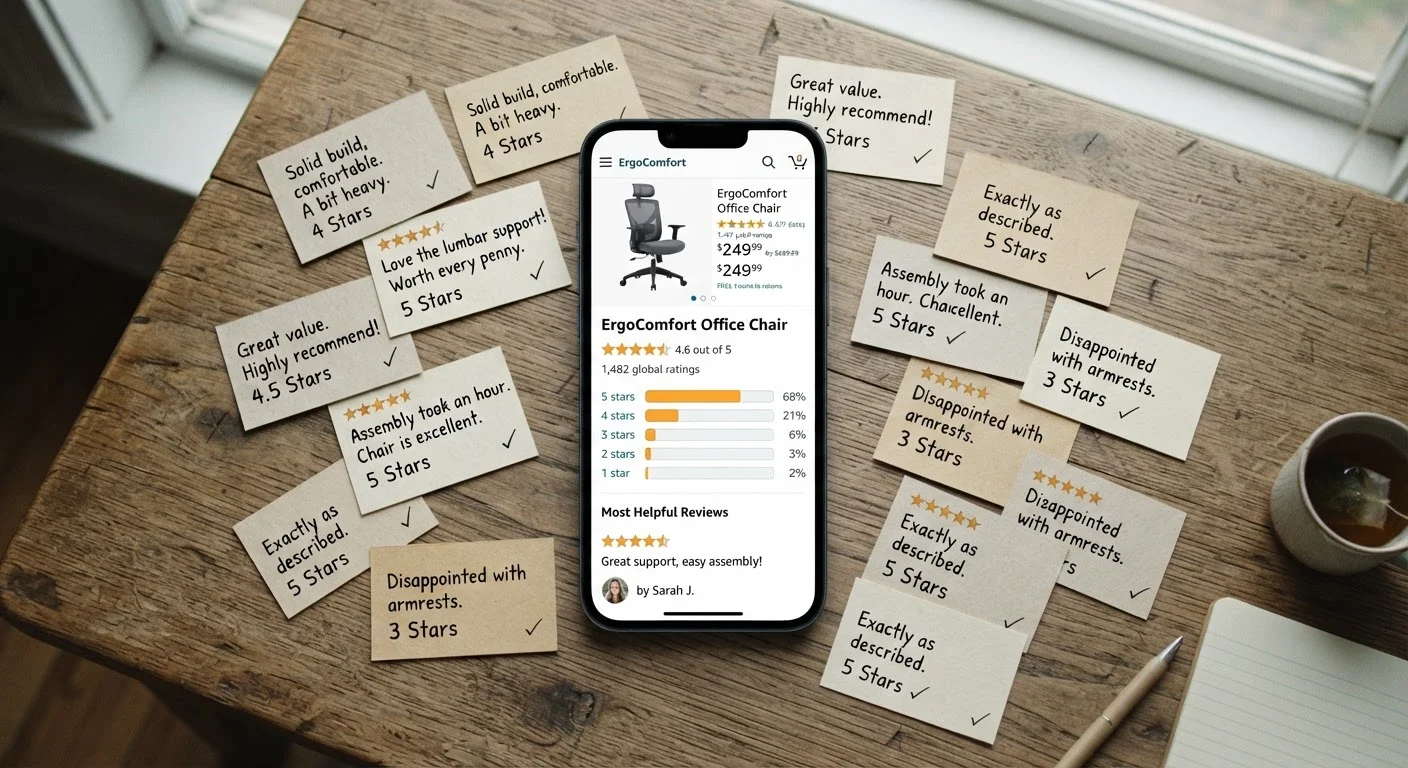
Photo credit: TrendingExperts.net
In this article
Aggregate star ratings obscure critical detail. Discover how to read review distributions, recency, and verified-purchase ratios for a more accurate picture.
Key Takeaways
- An aggregate star rating collapses thousands of diverse opinions into one misleading number.
- Review recency, verified-purchase ratios, and rating distributions reveal far more than the average.
- Fake and incentivized reviews can artificially inflate scores across major retail platforms.
- One-star and two-star reviews often contain the most specific and actionable quality information.
- Cross-referencing multiple signals gives a more accurate picture of real-world product performance.
The Problem with a Single Number
Star ratings are designed for speed. A single digit between one and five lets shoppers make split-second comparisons across hundreds of products. The problem is that speed comes at the cost of accuracy. That aggregate number is a mathematical average of thousands of individual experiences - different use cases, different expectations, different levels of product knowledge - collapsed into something that looks precise but often isn't.
Consider two products, both rated 4.1 stars. One has 90% of its reviews clustered between four and five stars. The other has 60% five-star reviews and 30% one-star reviews, with very little in between. The average is the same; the quality story is completely different. The second product is polarizing in a way the headline figure completely conceals. Understanding this distinction is the foundation of smarter review reading.
The same logic applies across other aggregated rating systems. Why Rotten Tomatoes scores don't always match what audiences feel illustrates how a single composite number can diverge sharply from the experience of a typical viewer - the same principle holds in retail.
Common Mistakes Shoppers Make with Star Ratings
Treating the average star rating as a reliable quality signal.
Why it happens: Platforms display the aggregate prominently and algorithmically reward high-rated products with better placement, so shoppers understandably take it at face value.
Ignoring the recency of reviews when evaluating a product.
Why it happens: Most platforms show the overall average across the product's entire history, and shoppers rarely sort by date or check when the bulk of reviews were submitted.
Overlooking the verified-purchase ratio or review source.
Why it happens: Unverified reviews look identical to verified ones at a glance, and many shoppers don't realize the distinction exists or can be checked.
Skipping the one- and two-star reviews entirely.
Why it happens: Shoppers often dismiss low-rated reviews as outliers written by unusually demanding or difficult customers.
Conflating review volume with product credibility.
Why it happens: A product with 15,000 reviews feels more established and trustworthy than one with 200, even though volume alone says nothing about the authenticity or quality distribution of those reviews.
Beyond these individual errors, it helps to build a broader framework for product evaluation. Our complete product evaluation framework walks through how to combine review signals with specs, certifications, and return policies into a repeatable system you can apply across any category.
What to Look for Instead
Inflated Scores Are a Documented Problem
Independent researchers and consumer advocacy organizations have repeatedly found that a significant share of reviews on major e-commerce platforms are incentivized, manipulated, or outright fake. A product with 4.6 stars and 8,000 reviews is not automatically trustworthy - the composition of those reviews matters as much as the number. Always look past the headline figure before making a purchasing decision.
A more reliable approach treats star ratings as one input among several. Start with the rating distribution, not the average. Then sort by recency and read verified reviews from the past few months. Pay close attention to low-rated reviews for recurring complaints. Cross-check what reviewers say against the objective product information in the listing itself - vague material descriptions or missing specifications are separate red flags covered in our guide to quiet red flags in product listings.
Finally, consider whether brand reputation is carrying weight in your assessment. A recognized name doesn't guarantee a specific product performs well - and a lesser-known brand isn't automatically inferior. Our piece on brand reputation versus product performance breaks down how to weigh those factors independently.
42%
Share of reviews estimated as fake or unreliable
A 2023 analysis by Fakespot, a review-analysis service, estimated that roughly 42% of reviews across major e-commerce platforms showed signs of being unreliable or inauthentic.
4.3
Average star rating shoppers consider acceptable
Consumer research has consistently found that most shoppers filter out products below approximately 4.0-4.3 stars, which concentrates competition - and manipulation - in a narrow rating band.

Author
Shopping Editorial Team
Shopping Editorial Team is the collective byline for our editorial team and contributor network. Articles published under this byline or an editorial pen name are researched, written, and reviewed according to our editorial standards for clarity, consistency, and independence before publication.
View all articles →