
Price Tracking Tools: What They Do, What They Don't, and How to Use Them
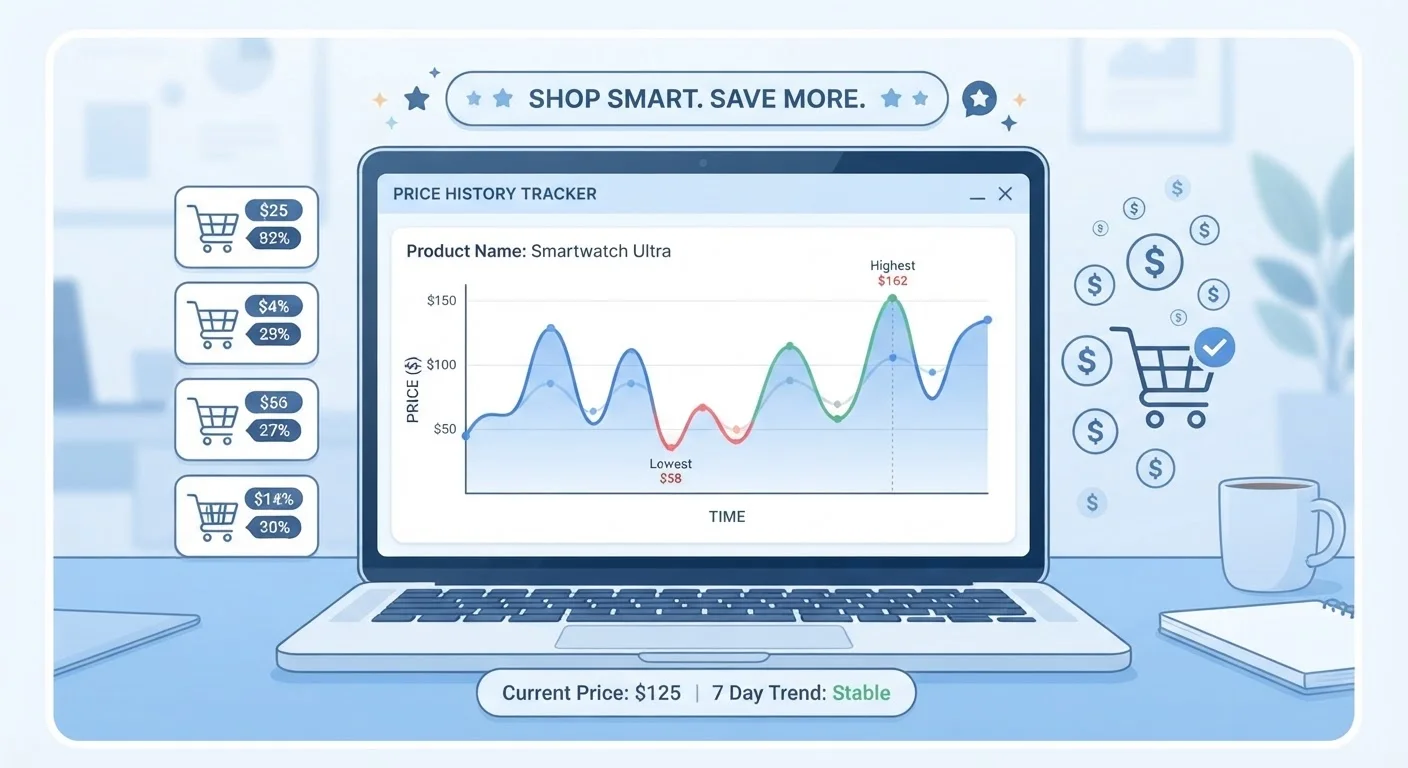
Photo credit: TrendingExperts.net
In this article
Browser extensions and price history tools can help — but they have real limitations. Here's an honest look at what they actually track.
Key Takeaways
- Price tracking tools show historical pricing data, helping you judge whether a current price is genuinely low.
- These tools have real gaps: they often miss seller-specific pricing, bundled deals, and marketplace variation.
- Browser extensions that offer price tracking may also collect browsing data - a trade-off worth understanding.
- A low historical price doesn't guarantee the same price will return or that the product is right for your needs.
- Price history is one useful signal, not a complete picture of whether something is worth buying.
Exposes inflated reference prices used in promotions
By showing what a product actually sold for over time, these tools reveal when a "sale" price is just the normal price with a manufactured comparison figure attached.
Removes emotional pressure from purchase decisions
Seeing that an item has hit a given price multiple times before makes it easier to wait rather than act on artificial urgency created by countdown timers or limited-stock warnings.
Enables smarter timing for non-urgent purchases
If historical data shows prices consistently dip during certain periods, shoppers can plan purchases accordingly rather than buying at the first reasonable-looking price.
Price alerts reduce the need to actively monitor listings
Rather than repeatedly checking a product page, alert features do the monitoring passively and notify you only when the price meets your criteria.
Data gaps leave out third-party seller pricing
On marketplace platforms, tracked prices often reflect just one seller or the featured offer, missing significant variation in what other sellers charge for the same item.
Historical lows don't guarantee future prices
A product that hit $40 two years ago may never return to that price due to supply changes, discontinuation, or updated retailer strategy.
Extensions may collect significant browsing data
Some price-tracking extensions require broad page-reading permissions and may monetize user data through advertising or data partnerships, creating a real privacy trade-off.
Short tracking windows produce misleading baselines
A price history covering only a few weeks may miss seasonal swings, making a moderately discounted price look like a record low when it isn't.
Doesn't account for bundled deals or format differences
Prices tracked for one product variant - size, color, or bundle - may not reflect the pricing of the specific configuration you actually want to buy.
What Price Tracking Tools Actually Do
Price tracking tools - which come in the form of browser extensions, standalone websites, and retailer-specific features - monitor the listed price of a product over time and store that data. When you view a product page, the tool can display a graph showing whether the current price is historically high, low, or typical.
The core function is straightforward: instead of relying on a retailer's claim that a product is "50% off," you can check whether that item has ever actually sold near the so-called original price. This is valuable context, since many retailers use artificially inflated reference prices to make markdowns appear more dramatic than they are. For a deeper look at those tactics, see our piece on retail pricing tricks that inflate discounts.
Some tools also let you set price alerts, notifying you by email when an item drops to a target price. Others surface price comparisons across multiple sellers. These are genuinely useful features when used with realistic expectations.
Price Tracking Covers List Price Only
Most tools track the listed or advertised price of a product - not the final price after coupons, loyalty discounts, credit card rewards, or retailer-specific promotions. The price you actually pay may differ in either direction. Always factor in any available discounts when comparing the tracked price to what you'd genuinely spend at checkout.
Where These Tools Fall Short
Price tracking has meaningful blind spots that shoppers often overlook.
Data gaps leave out third-party seller pricing
On marketplace platforms, tracked prices often reflect just one seller or the featured offer, missing significant variation in what other sellers charge for the same item.
Historical lows don't guarantee future prices
A product that hit $40 two years ago may never return to that price due to supply changes, discontinuation, or updated retailer strategy.
Extensions may collect significant browsing data
Some price-tracking extensions require broad page-reading permissions and may monetize user data through advertising or data partnerships, creating a real privacy trade-off.
Short tracking windows produce misleading baselines
A price history covering only a few weeks may miss seasonal swings, making a moderately discounted price look like a record low when it isn't.
Doesn't account for bundled deals or format differences
Prices tracked for one product variant - size, color, or bundle - may not reflect the pricing of the specific configuration you actually want to buy.
One particularly common issue is marketplace complexity. On large retail platforms, a single product listing may be fulfilled by dozens of third-party sellers, each with their own price. Tracking tools typically log the lowest or most prominent price at any given moment - which means the history may not reflect the price you'd actually pay from a specific seller today.
It's also worth remembering that a low historical price doesn't mean that price will return. Manufacturers discontinue products, supply chains shift, and retailer pricing strategies change. Past price floors are informative, not predictive. To understand how seasonal cycles affect pricing more broadly, our article on seasonal pricing patterns offers useful context.
The Privacy Trade-Off with Browser Extensions
Many price-tracking browser extensions work by reading the pages you visit in order to identify products and retrieve pricing data. That functionality requires fairly broad permissions - and some extensions go further, collecting browsing behavior, purchase history, or search data to support advertising or data-brokering business models.
This doesn't mean all such extensions are harmful, but it does mean the trade-off deserves attention before you install. Review the extension's privacy policy, check what permissions it requests, and consider whether the developer is a known entity. Our related article on browser extension risks walks through how to evaluate what you've installed.
~170%
Typical pre-sale price inflation on some major sale events
Research published by consumer advocacy organizations has found that reference prices on major sale days are frequently inflated well before the event to make discounts appear larger.
12-18 months
Recommended price history window for reliable context
Consumer researchers generally suggest that at least a year of price history is needed to capture seasonal lows and high-traffic sale events meaningfully.
How to Use Price History Data Effectively
Getting real value from these tools means treating price history as one input, not a final verdict.
Exposes inflated reference prices used in promotions
By showing what a product actually sold for over time, these tools reveal when a "sale" price is just the normal price with a manufactured comparison figure attached.
Removes emotional pressure from purchase decisions
Seeing that an item has hit a given price multiple times before makes it easier to wait rather than act on artificial urgency created by countdown timers or limited-stock warnings.
Enables smarter timing for non-urgent purchases
If historical data shows prices consistently dip during certain periods, shoppers can plan purchases accordingly rather than buying at the first reasonable-looking price.
Price alerts reduce the need to actively monitor listings
Rather than repeatedly checking a product page, alert features do the monitoring passively and notify you only when the price meets your criteria.
Start by checking the length of the price history. A graph covering only 30 days is far less meaningful than one spanning 12-18 months, which will capture seasonal lows, major sale events, and typical pricing ranges. Also check whether the tool distinguishes between the main retailer and third-party sellers on the same listing.
Pair price data with value thinking. A product at its lowest-ever price is still a poor purchase if it doesn't meet your actual needs or will need replacing quickly. Our article on price versus real value covers frameworks for thinking beyond the sticker price.
Finally, use price alerts strategically for non-urgent purchases. Setting a target price and waiting is often more effective than reacting to a flash sale - and less prone to impulse-driven decisions. For guidance on evaluating time-limited offers, see when flash sales are actually worth it.

Author
Shopping Editorial Team
Shopping Editorial Team is the collective byline for our editorial team and contributor network. Articles published under this byline or an editorial pen name are researched, written, and reviewed according to our editorial standards for clarity, consistency, and independence before publication.
View all articles →