
Bodyweight Training: The Case For and Against Ditching the Weights
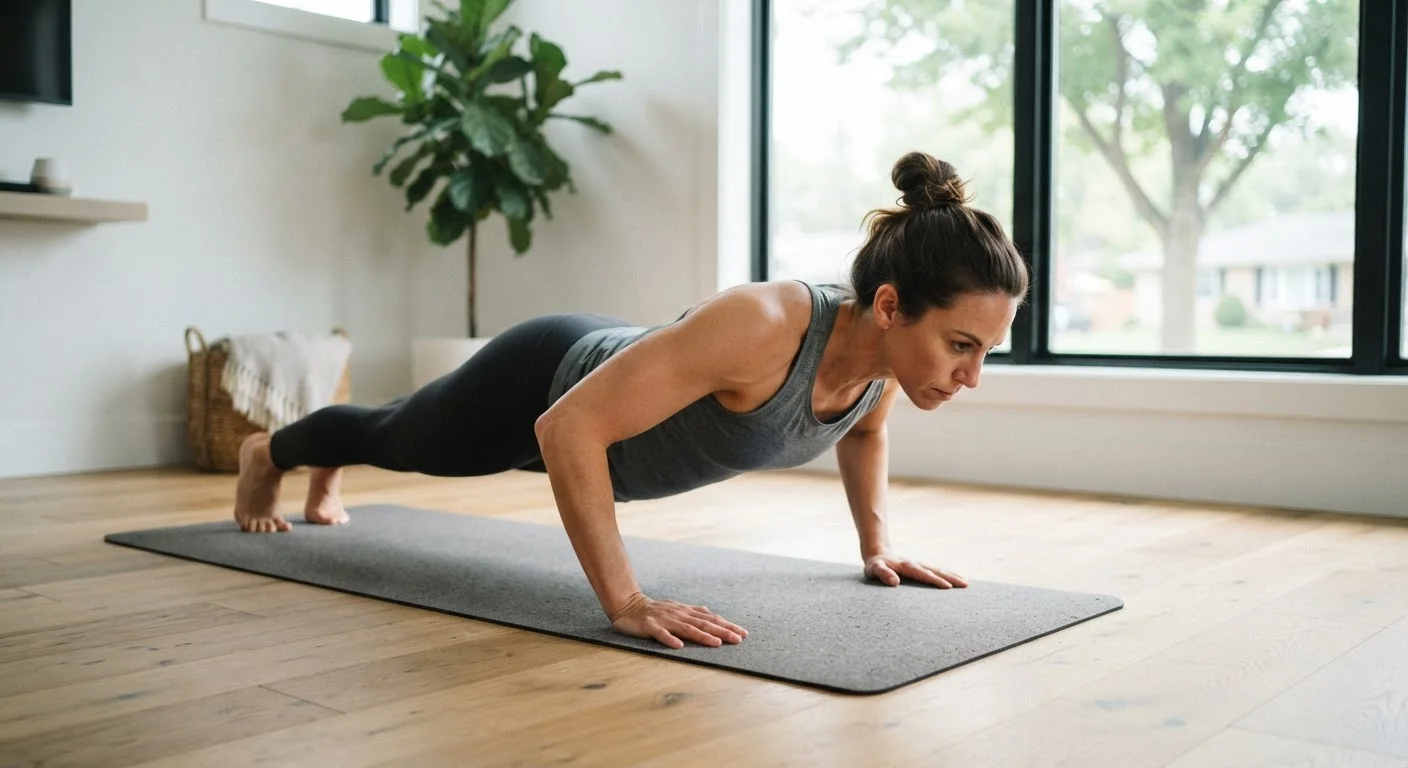
Photo credit: TrendingExperts.net
In this article
Bodyweight workouts are convenient and cost nothing, but they have real limits. A balanced look at what you gain — and what you might miss.
Key Takeaways
- Bodyweight training builds real strength and fitness with zero equipment costs.
- Progressive overload - the key to continued gains - is harder to achieve without added resistance.
- For muscle hypertrophy and bone density, free weights offer advantages bodyweight alone may not match.
- Bodyweight and weighted training work well together; most people don't have to choose one exclusively.
- Consistency and progression matter more than the specific method you choose.
Zero cost and no equipment required
Bodyweight workouts need nothing beyond your own body and a small amount of floor space, eliminating financial barriers to consistent exercise.
Effective for building foundational strength
Compound movements like push-ups, squats, and rows develop real muscular strength - especially for those who are new to structured training.
Can be done anywhere, anytime
Travel, schedule changes, and gym closures are not obstacles; a bodyweight routine adapts to nearly any environment.
Lower barrier to starting a consistent habit
Removing friction - no commute, no equipment setup - makes it easier to exercise regularly, which is the single most important factor in long-term fitness.
Emphasizes functional, multi-joint movement
Bodyweight exercises typically involve multiple muscle groups working together, which can improve coordination and everyday movement quality.
Progressive overload is harder to achieve
Without external load, making exercises progressively harder requires more creative programming - changing leverage or tempo - which has limits compared to simply adding weight.
Less effective for maximizing muscle hypertrophy
Building significant muscle mass generally requires heavier, measurable resistance; bodyweight exercise tends to plateau for experienced exercisers focused on size gains.
Limited bone density stimulus compared to weighted loading
External resistance is a key driver of bone remodeling; pure bodyweight training may not provide sufficient mechanical load, particularly for adults over 40.
Harder to isolate and target specific muscle groups
Machines and free weights allow precise loading of individual muscles, which bodyweight exercises cannot always replicate effectively.
Advanced progressions have a steep skill curve
Moves like pistol squats or handstand push-ups require significant balance and technique development before they provide meaningful strength stimulus.
What Bodyweight Training Actually Is
Bodyweight training uses your own body as resistance - think push-ups, squats, lunges, planks, and pull-ups. No barbells, no machines, no membership required. It spans a wide spectrum, from basic floor exercises suited to complete beginners all the way to advanced skills like pistol squats and handstand push-ups that challenge even experienced athletes.
The appeal is obvious: you can do it anywhere, anytime, and the entry cost is essentially zero. But convenience alone doesn't determine whether a training method is effective. The real question is whether bodyweight exercise can deliver the specific results you're after - and where it starts to show its limits. For a deeper look at the principles behind equipment-free exercise, see our complete guide to bodyweight training.
The Case For Bodyweight Training
There are genuinely strong reasons to build your fitness around bodyweight movement, especially if you're starting out or exercising outside a gym environment.
Zero cost and no equipment required
Bodyweight workouts need nothing beyond your own body and a small amount of floor space, eliminating financial barriers to consistent exercise.
Effective for building foundational strength
Compound movements like push-ups, squats, and rows develop real muscular strength - especially for those who are new to structured training.
Can be done anywhere, anytime
Travel, schedule changes, and gym closures are not obstacles; a bodyweight routine adapts to nearly any environment.
Lower barrier to starting a consistent habit
Removing friction - no commute, no equipment setup - makes it easier to exercise regularly, which is the single most important factor in long-term fitness.
Emphasizes functional, multi-joint movement
Bodyweight exercises typically involve multiple muscle groups working together, which can improve coordination and everyday movement quality.
Research consistently supports the idea that bodyweight exercises can produce meaningful improvements in muscular strength and endurance when performed with appropriate effort and progression. A 2019 review published in IJERPH found that bodyweight resistance training improved muscle strength comparably to equipment-based training in previously untrained individuals. That's a significant finding for anyone who assumes weights are essential from day one.
Beyond accessibility, bodyweight training tends to emphasize compound movements - exercises that work multiple muscle groups simultaneously - which can improve coordination, balance, and functional movement quality. If you're curious about structured routines, our no-equipment home workout routines offer practical starting points.
The Case Against Going Purely Bodyweight
The benefits are real, but so are the trade-offs. Understanding the limitations of bodyweight training helps you make an informed decision rather than an idealized one.
Progressive overload is harder to achieve
Without external load, making exercises progressively harder requires more creative programming - changing leverage or tempo - which has limits compared to simply adding weight.
Less effective for maximizing muscle hypertrophy
Building significant muscle mass generally requires heavier, measurable resistance; bodyweight exercise tends to plateau for experienced exercisers focused on size gains.
Limited bone density stimulus compared to weighted loading
External resistance is a key driver of bone remodeling; pure bodyweight training may not provide sufficient mechanical load, particularly for adults over 40.
Harder to isolate and target specific muscle groups
Machines and free weights allow precise loading of individual muscles, which bodyweight exercises cannot always replicate effectively.
Advanced progressions have a steep skill curve
Moves like pistol squats or handstand push-ups require significant balance and technique development before they provide meaningful strength stimulus.
The most significant challenge is progressive overload - the principle that muscles need increasingly greater stimulus to keep adapting. With weights, you add five pounds. With bodyweight, your options are more limited: you can change leverage, tempo, range of motion, or progress to a harder variation. This is manageable for intermediate exercisers but becomes genuinely restrictive for those pursuing significant muscle hypertrophy.
Bone density is another concern worth noting. Weight-bearing resistance exercise - particularly with external load - has a well-documented effect on stimulating bone remodeling. For adults over 40, this becomes increasingly important. Our article on strength training after 40 covers this distinction in more detail.
Bodyweight Training and Bone Health
While bodyweight exercise is beneficial for overall health, it may not provide the same bone-loading stimulus as training with external weights. This distinction is particularly relevant for postmenopausal women and adults over 50, who face higher risk of bone density loss. If bone health is a priority for you, consult a healthcare provider or certified fitness professional about incorporating appropriate resistance training.
Finding the Right Balance
The framing of bodyweight versus weights as an either/or choice is, in most cases, a false dilemma. Many effective training programs blend both approaches - using bodyweight movements for warm-ups, skill work, and conditioning while incorporating free weights or resistance bands for targeted loading.
If you're new to structured exercise entirely, bodyweight training is an excellent place to start. It teaches movement patterns, builds baseline strength, and reduces injury risk compared to jumping straight into heavy lifting. Our beginner's guide to strength training explains how to layer in resistance work as your fitness develops.
Regardless of method, what drives results is consistent effort and measurable progression over time. Tracking whether you're actually improving matters more than which tool you use. For practical ways to assess your progress beyond the bathroom scale, see our guide on tracking fitness progress without fixating on the scale.
This article is for general informational purposes only and does not constitute medical or professional fitness advice. Consult a qualified healthcare or fitness professional before beginning any new exercise program, especially if you have existing health conditions or injuries.

Author
Beauty Editorial Team
Beauty Editorial Team is the collective byline for our editorial team and contributor network. Articles published under this byline or an editorial pen name are researched, written, and reviewed according to our editorial standards for clarity, consistency, and independence before publication.
View all articles →