
Tire Pressure and Why It Affects More Than Just Your Fuel Economy
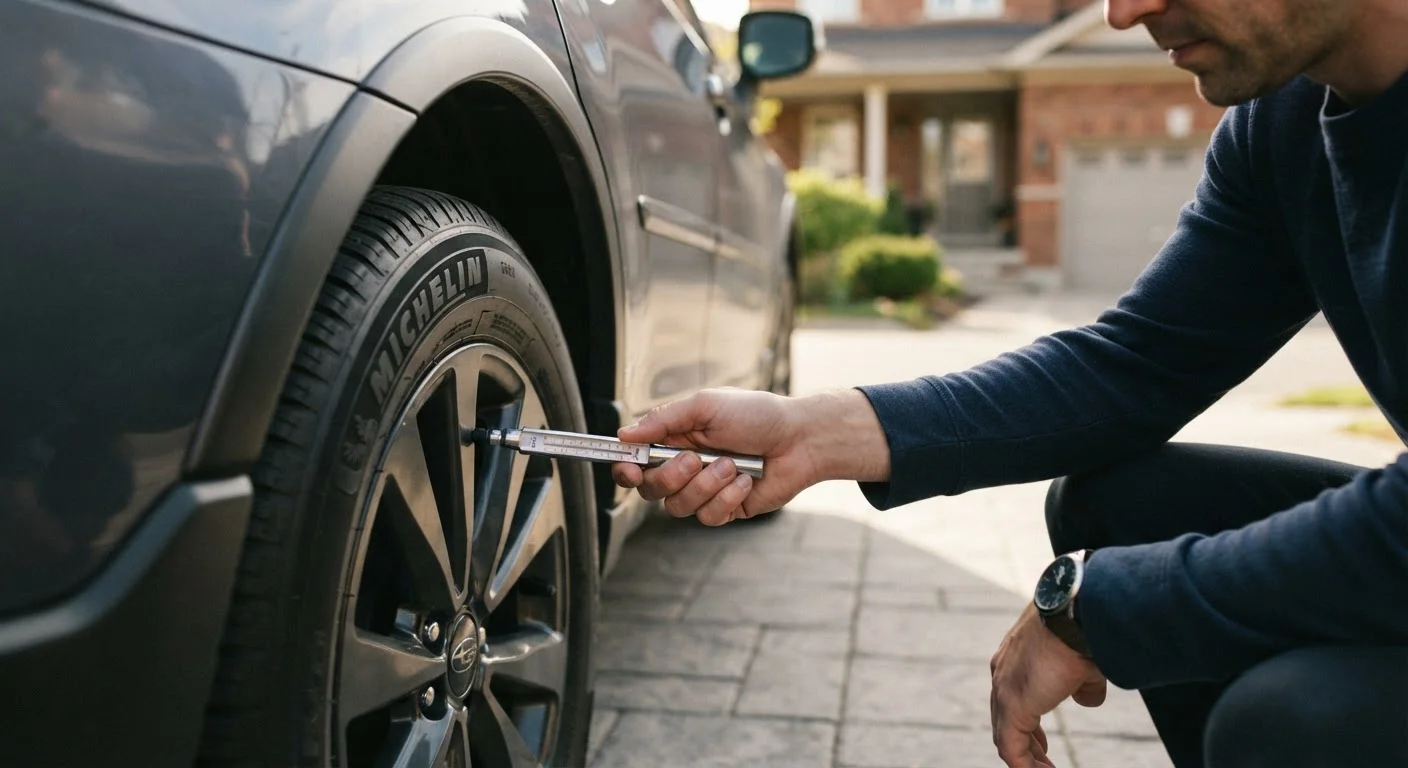
Photo credit: TrendingExperts.net
In this article
Proper tire inflation touches safety, tread wear, and ride quality. Learn what PSI means, where to find your correct number, and how to check it yourself.
Key Takeaways
- Your correct tire PSI is found on the driver's door jamb sticker, not on the tire sidewall.
- Underinflated tires are responsible for a significant share of tire-related crashes each year.
- Tire pressure drops roughly 1 PSI for every 10°F drop in outside temperature.
- Overinflated tires reduce traction and make the ride harsher, not just safer.
- Check pressure when tires are cold - before driving more than a mile - for an accurate reading.
- Most vehicles built after 2008 have a Tire Pressure Monitoring System (TPMS), but it only alerts at significant under-inflation.
What PSI Actually Means - and Where to Find Your Number
Every tire holds air under pressure, and that pressure is measured in PSI - pounds per square inch. Think of it as the firmness level your vehicle needs to carry its own weight and yours safely down the road.
The number you're looking for is on a sticker inside the driver's door jamb. It reflects what the vehicle's engineers determined is optimal for ride quality, handling, and load capacity - not a universal standard. Front and rear tires sometimes have different recommended pressures, especially on trucks and SUVs that carry variable cargo loads.
One common mistake: reading the PSI number molded into the tire sidewall. That figure is the maximum pressure the tire can physically hold, not your recommended inflation level. Using it as your target can actually be dangerous, reducing traction and making the tire more brittle to road impacts.
Spare Tires Have Different Pressure Requirements
Compact spare tires (often called 'donut' spares) typically require a much higher PSI - often 60 PSI - than your regular tires. Full-size spare tires should be inflated to the same pressure as the drive tires. Check your owner's manual for the spare's specific recommendation, and inspect it periodically even if you haven't used it.
The Real Consequences of Running at the Wrong Pressure
Tire pressure affects four things most drivers don't connect to it: safety, tread wear, fuel economy, and ride quality.
Safety is the most serious concern. Underinflated tires flex excessively as they roll, generating internal heat. Heat is one of the primary causes of tire blowouts - sudden failures that can cause a driver to lose control. The National Highway Traffic Safety Administration (NHTSA) has identified underinflation as a significant factor in tire-related crashes.
Tread wear is visibly affected by pressure. An underinflated tire wears faster on its outer edges; an overinflated tire wears through the center strip. Both patterns shorten tire life and can signal an alignment or pressure issue - something explained in more depth in our guide to reading tire tread wear patterns.
Fuel economy suffers when tires are soft. Underinflated tires increase rolling resistance - the engine has to work harder to push the vehicle forward. The effect is real, if modest, and adds up over thousands of miles.
Ride quality swings in both directions. Too little air makes the car feel spongy or sluggish in corners. Too much makes every bump feel jarring, transmitting road imperfections more sharply into the cabin.
~1 PSI
Pressure lost per 10°F temperature drop
The U.S. Department of Energy notes that tire pressure changes approximately 1 PSI for every 10-degree Fahrenheit change in ambient temperature.
25%
Under-inflation threshold to trigger TPMS alert
Federal TPMS standards require a dashboard warning when any tire falls 25% or more below the vehicle manufacturer's recommended PSI.
~0.2% per PSI
Fuel economy loss per PSI underinflation
The U.S. Department of Energy estimates fuel economy drops by roughly 0.2% for each 1 PSI the tires are underinflated below the recommended level.
How to Check Tire Pressure Correctly
Checking tire pressure is a five-minute task requiring only an inexpensive tire pressure gauge, available at any auto parts store or gas station. The process works best when tires are cold - meaning the vehicle hasn't been driven more than a mile in the past three hours. Driving heats air inside the tire, temporarily raising the reading and giving you a falsely high number.
- Remove the valve cap from the tire's valve stem - the small rubber or metal nub on the inner rim edge.
- Press the gauge firmly and squarely onto the valve stem. A hissing sound usually means the seal isn't tight; reposition and try again.
- Read the PSI displayed on the gauge.
- Compare to your door jamb sticker and add or release air as needed.
- Replace the valve cap securely.
If you need to add air, most gas stations have air compressors available. Add a small amount, check again, and repeat - it's easy to overshoot. To release air, press the small pin inside the valve stem with a fingernail or pen tip.
Tire pressure also responds to temperature. A drop of 10°F typically causes a loss of about 1 PSI. In fall and winter, tires that were properly inflated in summer may gradually read low - and vice versa in spring. Adjusting for season is part of routine vehicle maintenance that's easy to overlook.
Check Pressure Before Long Trips
Before any road trip, check all four tires - and your spare - when they're cold. Extended highway driving at the wrong pressure accelerates wear and, in the case of underinflation, increases blowout risk at sustained high speeds. A quick check before departure takes less time than a roadside tire change.
TPMS: Helpful but Not a Replacement for Checks
Since the 2007 model year, federal regulations require all new passenger vehicles sold in the United States to include a Tire Pressure Monitoring System (TPMS). A sensor in each wheel transmits pressure data to the vehicle's computer, and a dashboard icon lights up when pressure drops significantly.
The limitation is built into how the system is calibrated. The warning typically activates at about 25% below the recommended PSI - which, on a tire rated at 35 PSI, means the alert doesn't trigger until pressure falls to roughly 26 PSI. A tire at 28 or 30 PSI is measurably underperforming and increasing fuel consumption and wear, but the light stays off.
TPMS is best understood as a low-pressure alarm, not a pressure gauge. Manual monthly checks remain the reliable standard. Refer to our driving and safety guidance for a broader look at vehicle awareness habits that protect you on the road.
Frequently Asked Questions

Author
Automotive Editorial Team
Automotive Editorial Team is the collective byline for our editorial team and contributor network. Articles published under this byline or an editorial pen name are researched, written, and reviewed according to our editorial standards for clarity, consistency, and independence before publication.
View all articles →