
Screen Adaptations: What Gets Lost (and Gained) When Books Become Films or Shows
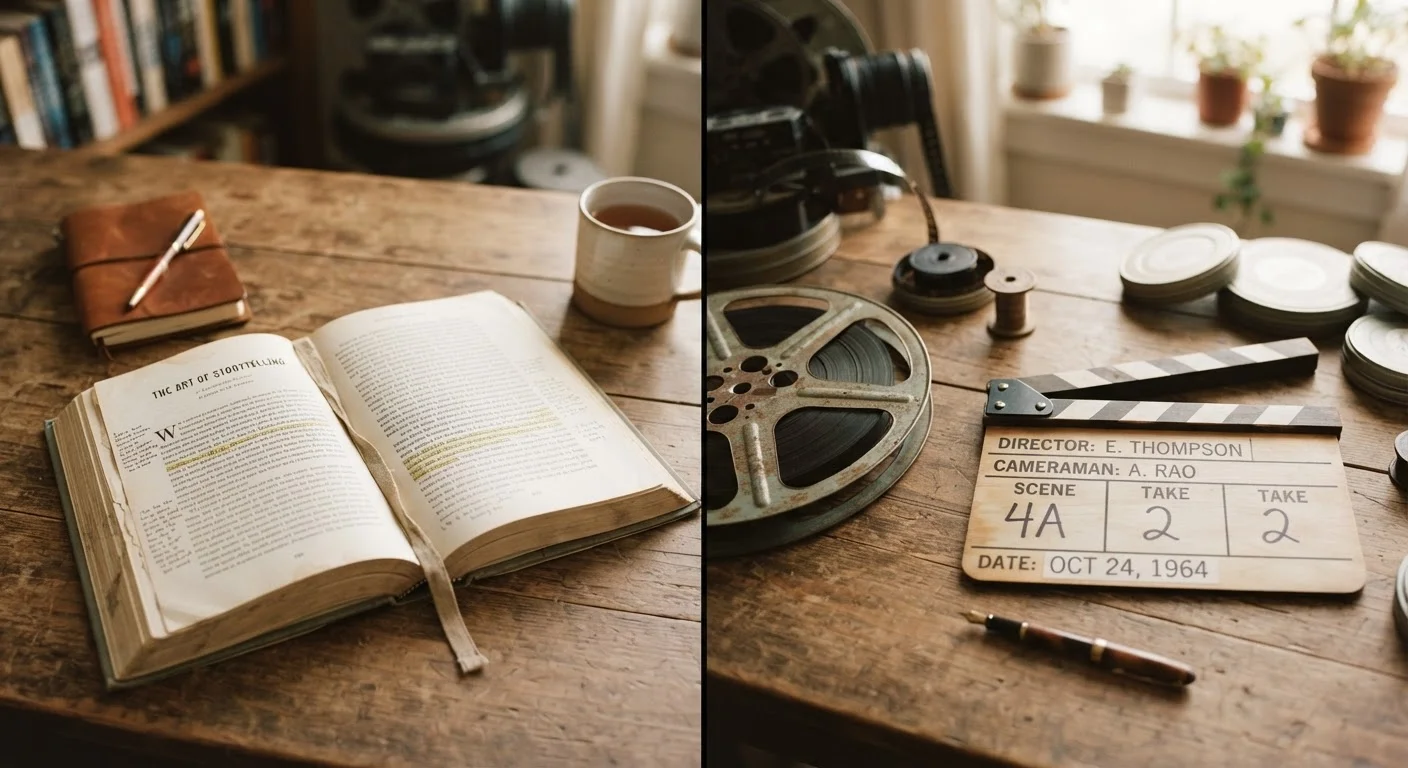
Photo credit: TrendingExperts.net
In this article
Adaptations always involve trade-offs. Understand what storytelling elements translate well to the screen—and which ones almost never survive.
Key Takeaways
- Screen adaptations always require trade-offs - no film or show perfectly replicates a book.
- Visuals and performance can deepen characterization in ways prose cannot always achieve.
- Interior monologue and narrative voice are among the hardest elements to translate to screen.
- Television series formats often allow more faithful, expansive storytelling than feature films.
- Readers who love a book tend to judge adaptations more harshly than viewers who come in fresh.
Performance adds emotional depth prose can't replicate
A skilled actor's face communicates nuance in real time, translating internal states that prose describes into something viscerally felt by the audience.
Music and design create irreplaceable sensory atmosphere
Composers and production designers add layers of mood and world-building that a written description can only gesture toward, deepening emotional immersion.
Television allows expansive, faithful world-building
Serialized formats give complex novels the runtime they need, allowing subplots and secondary characters to breathe rather than be cut for pacing.
Visual storytelling can compress time efficiently
A montage or a single evocative image can convey years of change in seconds, sometimes more powerfully than extended prose passages.
Adaptations introduce stories to entirely new audiences
Many readers first discover beloved novels through screen versions, significantly expanding a story's cultural footprint and longevity.
Interior monologue almost never translates intact
A character's rich internal voice - the defining quality of many great novels - is nearly impossible to render on screen without clunky voiceover that flattens the experience.
Subplots and secondary characters get cut
Runtime and budget pressure mean supporting storylines that give novels their texture are routinely compressed or eliminated, leaving the world feeling smaller.
Reader imagination is replaced by a fixed visual
Casting and design choices lock in one interpretation of characters and settings, potentially overwriting the personal mental images readers have built and cherished.
Tonal nuance is difficult to reproduce cinematically
Irony, ambiguity, and unreliable narration are tools prose handles elegantly; translating them to screen often requires heavy-handed devices that undercut the subtlety.
Commercial pressures can override artistic fidelity
Studio notes, test screenings, and marketing concerns regularly reshape adaptations in ways that prioritize broad appeal over faithfulness to the source material's intent.
Why Adaptation Is Always a Translation, Not a Copy
When a publisher sells film rights to a novel, what the studio actually acquires is the right to interpret the story - not duplicate it. Film and television are fundamentally different languages than prose. A novelist can spend three pages inside a character's head without losing the reader's attention; a filmmaker has roughly ten seconds of close-up before an audience starts fidgeting. That gap forces every adapter to make choices that fans of the original will notice and debate for years.
Understanding adaptation as translation rather than reproduction reframes the whole conversation. Just as a Spanish poem loses certain rhythms when rendered in English, a novel loses certain textures when rendered in images and sound. The interesting question isn't what's missing - something always is - but whether the new form finds equivalents that honor the original's spirit.
This tension has produced some of cinema's most celebrated works. Francis Ford Coppola's The Godfather departed from Mario Puzo's novel in meaningful structural ways, yet is widely considered to have deepened the source material's themes. Conversely, some word-for-word faithful adaptations feel curiously lifeless on screen, because what made the book work was invisible on the page.
What Adaptations Do Well: The Genuine Gains
Performance adds emotional depth prose can't replicate
A skilled actor's face communicates nuance in real time, translating internal states that prose describes into something viscerally felt by the audience.
Music and design create irreplaceable sensory atmosphere
Composers and production designers add layers of mood and world-building that a written description can only gesture toward, deepening emotional immersion.
Television allows expansive, faithful world-building
Serialized formats give complex novels the runtime they need, allowing subplots and secondary characters to breathe rather than be cut for pacing.
Visual storytelling can compress time efficiently
A montage or a single evocative image can convey years of change in seconds, sometimes more powerfully than extended prose passages.
Adaptations introduce stories to entirely new audiences
Many readers first discover beloved novels through screen versions, significantly expanding a story's cultural footprint and longevity.
The most underappreciated advantage of a screen adaptation is performance. A skilled actor can communicate grief, irony, or deception in a single glance - information that prose might require a paragraph to convey. Actors like Meryl Streep or Anthony Hopkins have been credited with expanding the dimensionality of characters that readers found compelling but one-note on the page.
Production design and score add another layer prose can never supply. A novel describes a crumbling Victorian manor; a film makes you feel its cold and smell its damp. Composers like John Williams or Jonny Greenwood have written scores that become inseparable from a story's emotional identity, creating resonance no book jacket can match.
Television's longer format has become a particular strength for complex, multi-character novels. Series like HBO's The Wire (loosely drawn from journalism) or Prime Video's The Boys demonstrate how episodic structure can sustain world-building and character development that a two-hour film would be forced to compress fatally.
What Almost Never Survives: The Real Losses
Interior monologue almost never translates intact
A character's rich internal voice - the defining quality of many great novels - is nearly impossible to render on screen without clunky voiceover that flattens the experience.
Subplots and secondary characters get cut
Runtime and budget pressure mean supporting storylines that give novels their texture are routinely compressed or eliminated, leaving the world feeling smaller.
Reader imagination is replaced by a fixed visual
Casting and design choices lock in one interpretation of characters and settings, potentially overwriting the personal mental images readers have built and cherished.
Tonal nuance is difficult to reproduce cinematically
Irony, ambiguity, and unreliable narration are tools prose handles elegantly; translating them to screen often requires heavy-handed devices that undercut the subtlety.
Commercial pressures can override artistic fidelity
Studio notes, test screenings, and marketing concerns regularly reshape adaptations in ways that prioritize broad appeal over faithfulness to the source material's intent.
The most consistent casualty of adaptation is interior voice - the narrator's or protagonist's running commentary that gives a novel its personality. Think of the wry, self-aware prose of Nick Carraway in The Great Gatsby or the dark spiral of Humbert Humbert in Lolita. Voiceover narration is the usual workaround, but it rarely reproduces the immersive quality of reading because the viewer's eye is already occupied.
Subplots and secondary characters are also frequent casualties, particularly in feature film adaptations. Studio economics demand runtime discipline, so supporting storylines - often the texture that makes a novel feel like a real world - get compressed or cut entirely. Fans of sprawling books like The Stand or Jonathan Strange & Mr Norrell know this pain intimately.
The Time Problem in Adaptation
Novels can compress or expand time with a single sentence - 'Twenty years passed' carries enormous weight on the page. Films must represent elapsed time visually through aging makeup, title cards, or montage sequences, each of which costs precious screen time and can interrupt narrative flow. It's one reason epic, multi-generational novels so frequently feel rushed when adapted into feature films.
Time is another casualty that rarely gets discussed. A novel can shift decades in a sentence; a film must represent that passage visually, which costs screen time and can flatten the sense of history that made the book feel epic.
How to Watch Adaptations With Fresh Eyes
Film critics and scholars often suggest a useful mental shift: try to evaluate an adaptation by asking what problem the filmmakers were solving, not just whether the result matches your mental image of the book. Every screenwriter who adapts a novel is making hundreds of micro-decisions about what the story is fundamentally about - and those decisions reveal interpretation, not incompetence.
It also helps to consider the adaptation's audience. A film version of a beloved novel must work for viewers who have never read the book. If it fails that audience, no amount of fidelity to the source matters commercially or culturally. The best adaptations thread the needle - satisfying newcomers while giving longtime fans something to recognize and celebrate.
For readers curious about branching into world cinema and encountering unfamiliar storytelling conventions, this guide to foreign-language film offers useful context on reading stories across cultural and formal divides. Similarly, if you're thinking about how audio choices affect your viewing experience, the evidence on subtitles vs. dubbed audio is worth a look - especially relevant when adaptations cross language boundaries.
Ultimately, the richest approach is to let the screen version and the book coexist as separate experiences. A great adaptation doesn't diminish a great novel any more than a cover version diminishes the original song. Both can live, and both can matter.

Author
Entertainment Editorial Team
Entertainment Editorial Team is the collective byline for our editorial team and contributor network. Articles published under this byline or an editorial pen name are researched, written, and reviewed according to our editorial standards for clarity, consistency, and independence before publication.
View all articles →