
Street Art and Graffiti: Where the Debate Over Legitimacy Stands
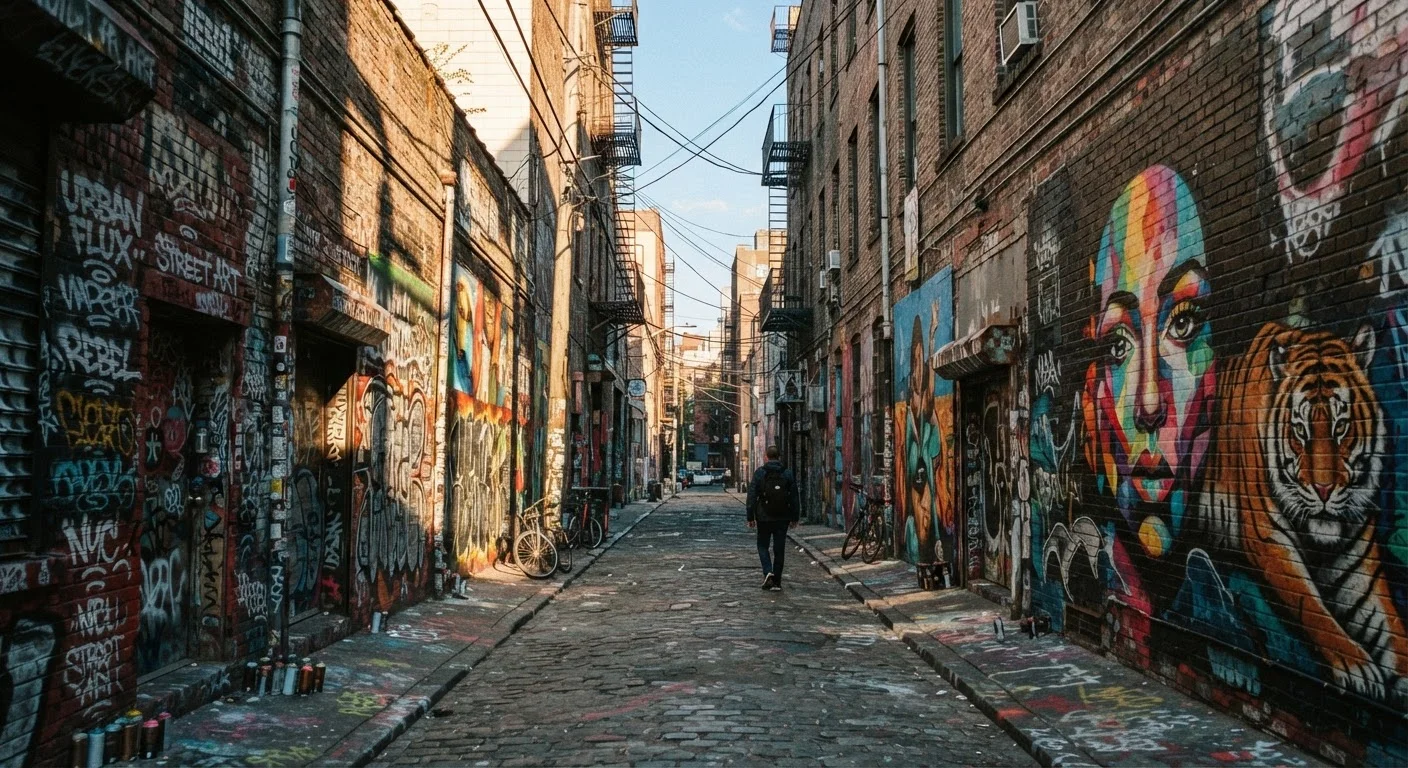
Photo credit: TrendingExperts.net
In this article
Street art fills galleries; graffiti still gets painted over. Explore the cultural, legal, and artistic lines that divide them.
Key Takeaways
- Street art typically involves permission or commission; graffiti is generally unauthorized and illegal.
- Both forms share a common history rooted in New York City's 1970s hip-hop and urban culture.
- The line between them has blurred significantly as gallery culture embraces once-outlaw aesthetics.
- Graffiti's legal risks and subcultural codes remain central to its identity and community.
- Institutions like the Tate and MoMA now collect and exhibit work originally created on city streets.
- Context - not just content - largely determines which label a piece receives.
Same Spray Can, Very Different Stories
Walk through any major American city and you'll encounter two things that look strikingly similar but carry very different cultural weight: a sweeping commissioned mural celebrating local history, and a cluster of tags sprayed overnight on a transit wall. Both involve paint and public surfaces. But the conversation around them - legal, artistic, and social - couldn't be more different.
The distinction matters because it shapes how art is funded, preserved, prosecuted, and remembered. Street art, in contemporary usage, generally refers to visual work created in public spaces with permission - whether from a property owner, a city arts program, or a festival organizer. Graffiti, by contrast, is most precisely understood as unauthorized mark-making: letters, tags, throw-ups, and pieces applied without consent, often under cover of darkness. That legal difference carries enormous consequences, from who gets a gallery show to who gets arrested.
Just as the line between indie and mainstream music has blurred, the boundary between street art and graffiti has become genuinely difficult to draw - and that's precisely what makes the debate worth having.
A Shared Origin, Diverging Paths
Both forms trace their modern roots to New York City in the late 1960s and 1970s, when writers like Taki 183 and Cornbread began leaving their names across subway cars and building walls. What started as a statement of presence - I was here - evolved rapidly into an elaborate subculture with its own hierarchy, aesthetics, and vocabulary. Wildstyle lettering, burners, and throw-ups all developed within this tradition, deeply intertwined with hip-hop's emergence as a broader cultural force.
Street art as a distinct category began to crystallize in the 1980s and 1990s, as artists like Keith Haring and Jean-Michel Basquiat moved from illegal work into gallery spaces - without fully abandoning the street. By the 2000s, figures like Banksy had made the tension between the street and the institution central to their artistic identity. Today, cities from Philadelphia to Los Angeles run dedicated mural programs, and festivals like Wynwood Walls in Miami have turned once-industrial neighborhoods into open-air galleries.
| Criterion | Street Art | Graffiti |
|---|---|---|
| Legal status | Typically permitted or commissioned | Generally unauthorized; often illegal |
| Primary intent | Visual storytelling, community message | Identity, territory, subcultural recognition |
| Relationship to institutions | Increasingly gallery- and museum-friendly | Deliberately outside institutional approval |
| Cultural roots | Shared NYC origins; shaped by fine art crossover | Hip-hop subculture; writing traditions |
| Longevity of work | Often preserved and maintained | Frequently buffed or painted over |
| Public reception | Broadly celebrated in urban planning | Contested; valued within subculture |
The pathway diverged, but the DNA remains shared - which is exactly why the argument over legitimacy stays so heated.
The Legitimacy Debate: Who Decides What's Art?
Much of the friction in this debate is really a question about institutional authority. When a museum acquires a Banksy print or a city commissions a 10-story mural, the establishment is extending its blessing - and with that comes funding, protection, and prestige. Critics within graffiti culture argue this process sanitizes something that was powerful precisely because it existed outside permission structures.
There's also a class and access dimension worth naming. Graffiti writers have historically skewed younger and less economically privileged, using public walls as the only canvas available to them. Street art commissions, meanwhile, often go to artists with existing professional networks or social media followings. As fine art and commercial art share tools but serve different masters, street art and graffiti use the same aerosol cans but answer to very different audiences.
Context Shapes the Label
The same artist can produce both street art and graffiti depending on whether a given piece was authorized. Shepard Fairey, best known for the Barack Obama 'Hope' poster, built his career through unauthorized wheat-paste campaigns before becoming a sought-after commercial and gallery artist. Permission - not style, technique, or even content - is often the deciding factor in which category a work falls into.
None of this resolves the debate - but it does clarify what's actually at stake when cities buff (paint over) graffiti while simultaneously funding murals two blocks away.
Where Things Stand Today
The contemporary art world has largely embraced street art while remaining ambivalent about graffiti. Institutions including the Tate Modern and MoMA have exhibited work with street origins, and auction houses have sold pieces by artists like Banksy and Os Gemeos for significant sums. Yet writers operating in the traditional graffiti sense - unauthorized, name-driven, rooted in subculture - continue to face prosecution, fines, and erasure.
What's emerging is less a resolution than a dual existence. Street art occupies an increasingly legitimate cultural space, commissioned and celebrated. Graffiti persists as its own living subculture, indifferent or even hostile to that legitimacy. For everyday art lovers, both offer something genuine: one a form of shared public beauty, the other a window into what creative expression looks like when it asks no one's permission.
$1.87M
Banksy's 'Devolved Parliament' auction price
Sotheby's sold this street-art-origin canvas in 2019, illustrating how work rooted in unauthorized practice can command serious institutional market value.
100+
U.S. cities with active mural programs
According to Americans for the Arts, publicly commissioned mural and street art programs operate in over 100 American cities, reflecting mainstream municipal acceptance of the form.
If you're curious about how these dynamics echo in other creative disciplines, the comparison between oil painting and digital illustration explores how medium shapes identity and perception in similar ways.

Author
Entertainment Editorial Team
Entertainment Editorial Team is the collective byline for our editorial team and contributor network. Articles published under this byline or an editorial pen name are researched, written, and reviewed according to our editorial standards for clarity, consistency, and independence before publication.
View all articles →