
Making Sense of Job Titles: Why the Same Role Has a Dozen Different Names
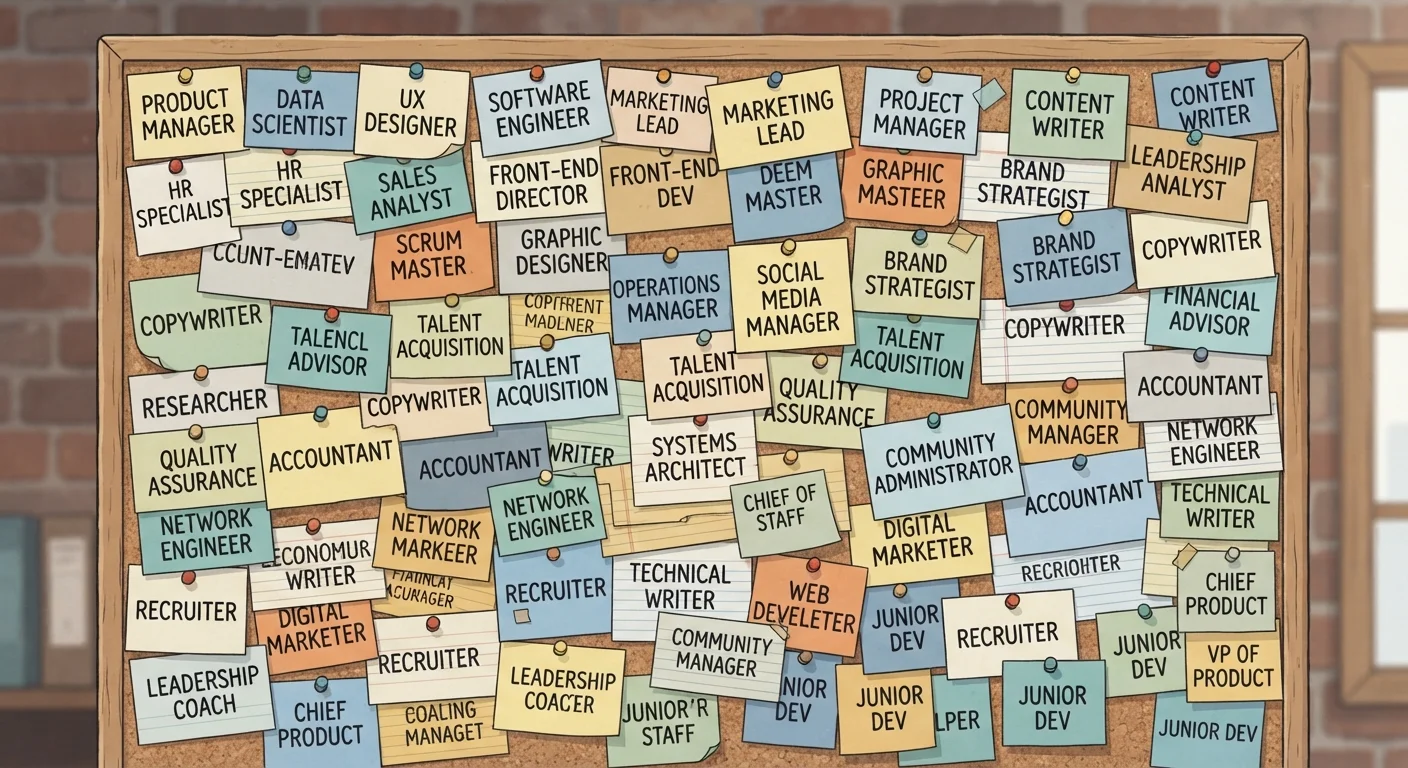
Photo credit: TrendingExperts.net
In this article
Job title inconsistency across industries makes searching harder than it should be. This reference breaks down how to find the right terms for your field.
Why Job Titles Don't Follow a Standard
If you've ever searched for "marketing coordinator" jobs and found wildly different roles - some entry-level, some requiring five years of experience - you've run into one of the most frustrating quirks of the modern job market: there is no governing body that standardizes job titles. Companies create them internally, often based on organizational culture, industry norms, budget constraints, or, frankly, what sounds most appealing to a candidate.
The result: a single functional role can carry dozens of different titles across employers. A person who writes software professionally might be listed as a Software Engineer, Developer, Programmer, Software Developer, Coder, or even a Member of Technical Staff. None of these is wrong - they just reflect different company conventions.
This matters practically. When you search job boards using only one title, you miss postings for identical work listed under different names. When you write your resume, using a title no one searches for buries your profile in applicant tracking systems. Understanding the logic behind title variation helps you search smarter and position yourself more accurately. See also: how applicant tracking systems evaluate your application.
| Primary source for standardized occupations | O*NET Online (U.S. Dept. of Labor) (onetonline.org - free public resource) |
| Number of occupational categories tracked by O*NET | 900+ (O*NET database, regularly updated) |
| Common cause of title mismatch | No industry-wide naming standard exists |
| Recommended approach for searching | Search by skill/task keywords, not title alone |
| Title inflation risk | Elevated titles without matching compensation are common in some sectors |
The Main Reasons Titles Vary
Title inconsistency isn't random - it follows a few predictable patterns:
- Industry conventions: Healthcare uses "Registered Nurse" where other fields might say "Clinical Specialist." Finance has "Analyst," "Associate," and "Vice President" in ways that map to seniority differently than in other sectors.
- Company size and structure: A startup might call someone a "Growth Hacker" while an established corporation calls the same function a "Digital Marketing Manager."
- Inflation and deflation: Some companies elevate titles to attract talent without raising salaries - the so-called "title inflation" trend. Others deliberately use modest titles internally for compensation equity reasons.
- Geographic and sector variation: The public sector uses classification titles (e.g., Administrative Officer III) that rarely appear in private-sector postings for equivalent work.
- Emerging fields: When a discipline is new - think data science in the early 2010s or AI roles today - consensus around titles hasn't formed yet, so you see wide variation.
Recognizing these patterns lets you decode a job posting more accurately than taking its title at face value.
Job title inflation
The practice of giving employees more senior-sounding titles without a corresponding increase in responsibilities or pay. Often used as a low-cost recruitment or retention tool.
Applicant Tracking System (ATS)
Software used by employers to collect, filter, and rank job applications. ATS tools often scan resumes for keyword matches, making title and skill terminology important to get right.
O*NET
The Occupational Information Network, a publicly available database maintained by the U.S. Department of Labor that classifies occupations by tasks, skills, and work context rather than job title alone.
Occupational classification
A standardized system for grouping jobs by function, used primarily in government labor statistics. Examples include the Standard Occupational Classification (SOC) system. These classifications rarely match exactly what employers put in a job posting.
Title map
A personal reference list of all job titles across industries and companies that describe work equivalent to your target role. Useful for broadening job searches and resume keyword strategy.
How to Find the Right Search Terms for Your Field
The practical fix is to build a personal title map - a short list of every title that describes your target role across different contexts. Here's a reliable process:
- Start with your core function. Define what you actually do in plain language: "I analyze sales data and build reports for leadership." Then search job boards using that description as keywords rather than a title.
- Mine job postings. When you find a role that matches your work, note its title. Over a few sessions, you'll collect five to ten variants worth tracking.
- Check O*NET Online. The U.S. Department of Labor's Occupational Information Network (O*NET) catalogs occupations by task, skill, and knowledge - not just by title. It's one of the most reliable free resources for understanding how the labor market groups related roles.
- Look at LinkedIn profiles of peers. Find people doing work similar to yours and note what they call themselves. This reflects real-world self-identification, not just company convention.
- Ask in professional communities. Field-specific forums and associations often have frank conversations about which titles carry weight and which are ignored by recruiters.
Once you have your title list, use it both in job searches and as keyword guidance when tailoring your resume to specific postings. Your resume title or summary line should mirror the language of the specific posting you're applying to, within honest bounds.
Honesty Matters When Mirroring Titles
Adapting your resume to reflect an employer's title language is a legitimate strategy - but there's a clear line. Never claim a title or seniority level you haven't held. Misrepresenting your background on a resume can result in immediate disqualification or termination after hire. The goal is accurate translation, not embellishment.
Title research also feeds directly into compensation research - the same role under different names can command different pay ranges on salary databases. This is worth knowing before you negotiate. Salary Research 101 walks through how to compare pay data across title variants.

Author
Careers Editorial Team
Careers Editorial Team is the collective byline for our editorial team and contributor network. Articles published under this byline or an editorial pen name are researched, written, and reviewed according to our editorial standards for clarity, consistency, and independence before publication.
View all articles →