
Skincare Claims That Sound Scientific But Rarely Are
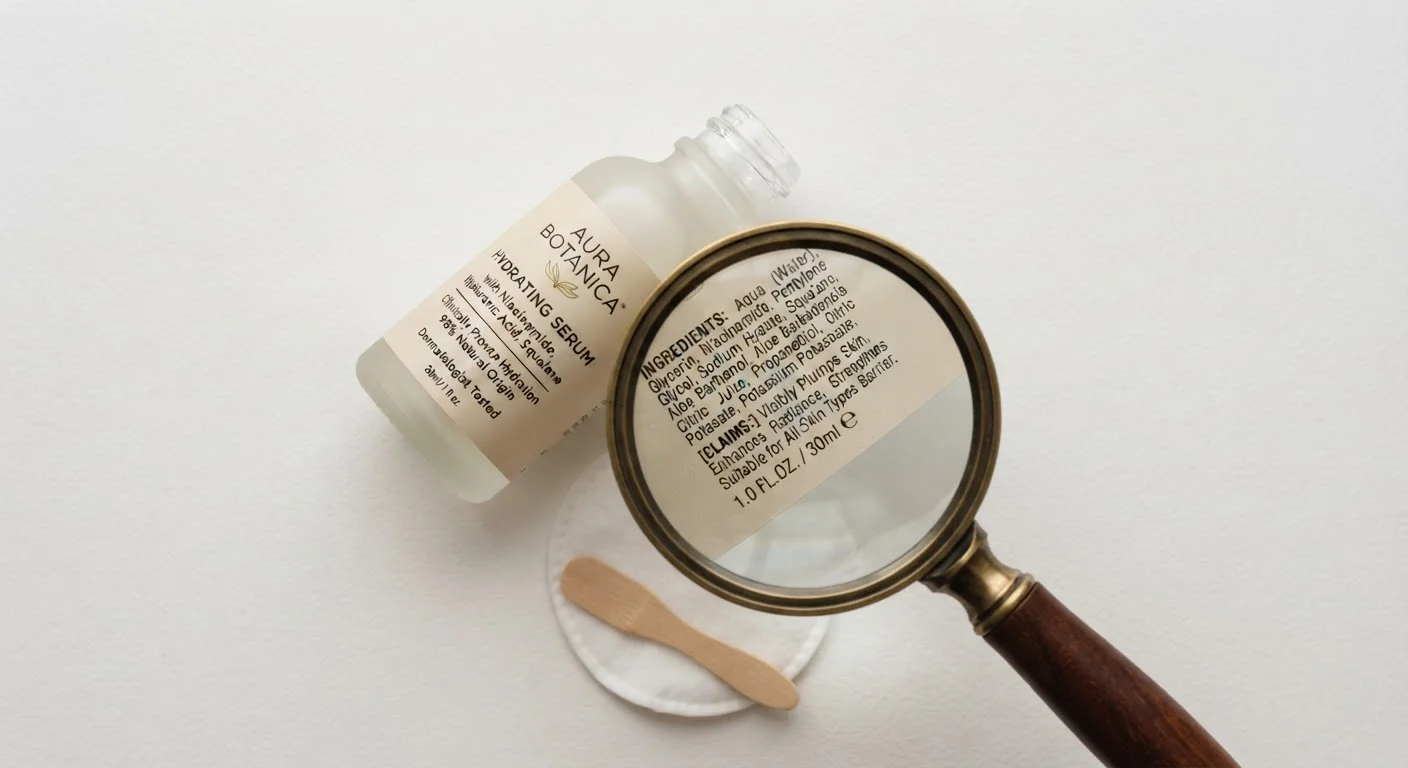
Photo credit: TrendingExperts.net
In this article
Words like 'clinically tested,' 'dermatologist-approved,' and 'toxin-free' appear everywhere. Here's what they actually mean — and what they don't.
Key Takeaways
- Terms like 'clinically tested' and 'dermatologist-approved' have no standardized legal definition in the U.S.
- 'Toxin-free' and 'chemical-free' are meaningless phrases - all matter is made of chemicals.
- 'Hypoallergenic' does not guarantee a product won't trigger allergic reactions in any individual.
- Peer-reviewed, published studies offer far stronger evidence than brand-funded 'clinical' testing.
- Understanding label language helps you evaluate products on evidence rather than marketing impressions.
Why Skincare Language Gets Away With So Much
Skincare marketing operates in a regulatory grey zone. In the United States, cosmetic products - which include most moisturizers, cleansers, and serums - are not required to prove their claims before reaching store shelves. The FDA oversees safety, not efficacy. That means brands can use language that sounds scientific without meeting a scientific standard of proof.
The result is an industry where terms that imply rigorous testing are often self-defined, self-administered, or simply unregulated. Recognizing a few key patterns makes it easier to separate meaningful evidence from persuasive packaging. For a broader look at how this plays out across product categories, see our guide on certifications and safety labels worth trusting.
Common Claims - and What They Actually Mean
The myths below represent some of the most widely misunderstood phrases in skincare. Each one is regularly used to suggest scientific credibility - but the underlying reality is more complicated.
Myth
If a product says 'clinically tested,' it has been proven to work.
Fact
'Clinically tested' simply means some form of testing was conducted - it says nothing about the quality, size, or independence of that testing.
'Clinically tested' is an unregulated phrase. A brand can apply it after testing a product on as few as a handful of volunteers with no control group, no placebo, and no independent oversight. There is no U.S. regulatory requirement specifying what a 'clinical test' must involve for a cosmetic. When evaluating this claim, look for specifics: published results, sample size, study duration, and whether the research appeared in a peer-reviewed journal rather than a brand press release.
Myth
'Dermatologist-approved' means dermatologists have reviewed and endorsed this product.
Fact
The phrase typically means one or more dermatologists were paid to evaluate or endorse the product - a commercial arrangement, not an independent clinical judgment.
There is no certifying body that grants 'dermatologist-approved' status. A brand may pay a single dermatologist to review the formula, conduct a small user study among dermatologists, or simply survey practitioners who received the product. None of these processes resemble the independent review that 'approved' implies. The American Academy of Dermatology, for example, does not endorse individual consumer products. This pattern mirrors marketing language in other product categories - our piece on reading product specification sheets covers similar dynamics.
Myth
'Toxin-free' and 'chemical-free' products are safer than conventional alternatives.
Fact
No product can be chemical-free - water is a chemical. 'Toxin-free' is an undefined marketing term with no regulatory meaning.
Every substance, including those marketed as natural or clean, is composed of chemicals. The word 'toxin' in a beauty context is almost always used loosely to mean 'ingredient someone might find alarming,' rather than referencing a specific, scientifically established harm. Toxicity depends on dose, concentration, and individual factors - a principle known in pharmacology as 'the dose makes the poison.' For a deeper look at how this reasoning applies to specific hair care ingredients that carry similar stigma, see our guide on sulfates, silicones, and parabens.
Myth
'Hypoallergenic' products are safe for sensitive skin and won't cause reactions.
Fact
'Hypoallergenic' has no legal or scientific definition in the U.S. - the FDA attempted to regulate the term in the 1970s but the rules were never finalized.
Brands use 'hypoallergenic' to suggest their products are less likely to cause allergic reactions, but there is no standardized test or ingredient threshold behind the claim. An individual can react to virtually any ingredient, including those commonly found in products labeled hypoallergenic - such as fragrance components, preservatives, or botanical extracts. People with known sensitivities should review ingredient lists directly rather than relying on this label. Understanding what the skin barrier is doing during these reactions is also useful; our article on what your skin barrier actually does explains the underlying biology.
Myth
'Natural' ingredients are inherently gentler or more effective than synthetic ones.
Fact
Natural origin does not determine safety or efficacy - some of the most potent irritants are plant-derived, while many synthetic ingredients have strong safety records.
Poison ivy is natural. So is urushiol, the compound that causes its rash. Meanwhile, many synthetic ingredients - including certain preservatives and emollients - have extensive safety data and remain stable in formulas in ways that raw botanical extracts sometimes cannot. The 'natural equals good' heuristic is appealing but not scientifically grounded. Efficacy depends on molecular structure, concentration, and how an ingredient interacts with skin biology, not its origin. This same logic applies to how people evaluate food labels - a pattern explored in our piece on reading between the lines on healthy food marketing.
How to Evaluate Evidence That Actually Holds Up
When a brand references a study, a few questions cut through quickly. Was it published in a peer-reviewed journal? Was it conducted independently, or funded by the company selling the product? How many participants were involved, and over what time period? A study of 20 people run for two weeks carries far less weight than a randomized controlled trial replicated by independent researchers.
Brand-Funded Studies Deserve Extra Scrutiny
Research funded by the company selling a product is not automatically invalid, but it warrants careful evaluation. Conflicts of interest can influence study design, outcome selection, and how results are reported. When a brand cites its own research as proof of efficacy, look for whether that research was independently replicated and whether results were published in a peer-reviewed journal - not just in a press release or on a product page.
Ingredient transparency is a more reliable signal than claim language. A product that clearly lists active concentrations and links to published research on those ingredients offers more to evaluate than one that simply states it is 'scientifically advanced.' Our sunscreen label guide shows what genuinely standardized measurements look like in practice. Similarly, the science behind specific actives - like those covered in our piece on layering retinol, AHAs, and vitamin C - is grounded in decades of peer-reviewed research, not just label copy.
This article is for general informational purposes only and does not constitute medical or dermatological advice. Consult a qualified healthcare or skincare professional for guidance tailored to your individual skin concerns.

Author
Beauty Editorial Team
Beauty Editorial Team is the collective byline for our editorial team and contributor network. Articles published under this byline or an editorial pen name are researched, written, and reviewed according to our editorial standards for clarity, consistency, and independence before publication.
View all articles →