
Exercise Terms You'll Encounter in Workouts, Decoded
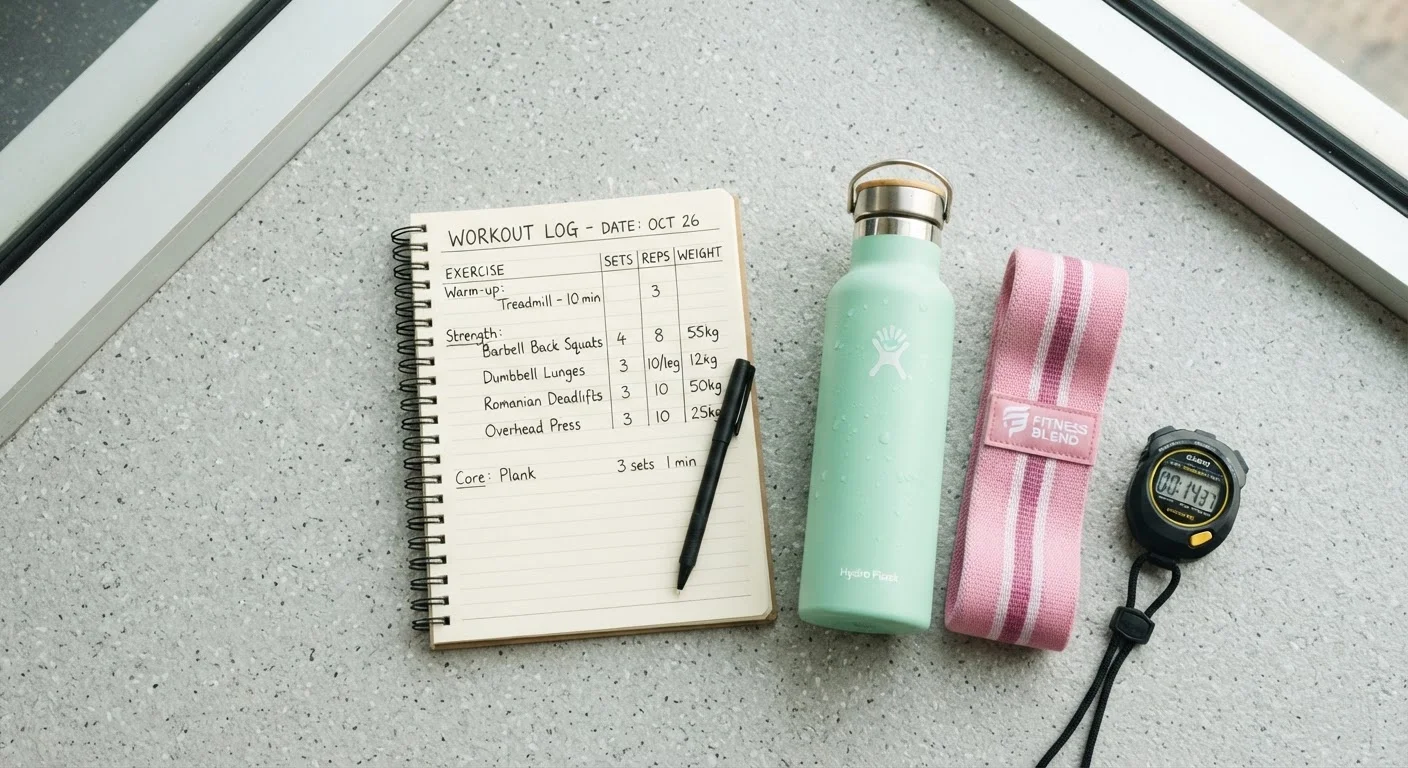
Photo credit: TrendingExperts.net
In this article
From 'AMRAP' to 'superset' — a plain-language glossary of common fitness terms so you can follow any workout without guessing.
Why Fitness Jargon Can Feel Like a Foreign Language
You load up a workout app, join a fitness class, or scroll through an exercise plan - and immediately hit a wall of abbreviations and terms that nobody bothered to explain. AMRAP. RPE. Superset. Time under tension. These phrases are common in gyms and fitness content, but rarely defined for newcomers.
This glossary cuts through that confusion. Whether you're just starting out or returning after a long break, understanding these terms helps you follow instructions confidently, work more safely, and get better results from any program.
Rep (Repetition)
One complete execution of a single exercise movement, from start position through full range of motion and back. Reps are the most basic unit of workout volume.
Set
A group of consecutive reps performed without stopping. Programs typically prescribe a number of sets per exercise, separated by rest intervals.
AMRAP
Stands for 'As Many Rounds (or Reps) As Possible.' A timed workout format where you complete as much work as you can within a set period, commonly used in functional and high-intensity training.
Superset
Two different exercises performed back-to-back with little to no rest in between. Supersets can save time and increase workout density by pairing complementary or opposing muscle groups.
RPE
Rate of Perceived Exertion - a subjective scale (usually 1-10) used to gauge how hard an effort feels during exercise. It helps regulate intensity when objective measurements like heart rate aren't available.
Progressive Overload
The practice of gradually increasing training demands - through added weight, reps, volume, or reduced rest - to continue prompting physical adaptation over time. It's a cornerstone principle of exercise science.
Compound Movement
An exercise that involves multiple joints and muscle groups working together, such as a squat or push-up. Compound movements are efficient for building functional, whole-body strength.
Eccentric Phase
The portion of a lift where the muscle lengthens under load - for example, lowering the barbell during a bench press. Controlled eccentric training is associated with muscle development and is a common source of post-workout soreness.
1RM (One-Rep Max)
The maximum weight a person can lift for one complete, correctly formed repetition of an exercise. Training loads are often prescribed as a percentage of an individual's 1RM.
HIIT
High-Intensity Interval Training - a format that alternates short bursts of intense effort with brief recovery periods. HIIT workouts are typically time-efficient and can challenge both aerobic and anaerobic energy systems.
Time Under Tension (TUT)
The total time a muscle spends under load during a set. Increasing TUT - often by slowing the eccentric phase - is used as a training variable to influence muscular endurance and hypertrophy.
Circuit
A series of exercises performed in sequence with minimal rest between exercises. After completing all exercises in the sequence, the trainee rests and then repeats the full circuit for the prescribed number of rounds.
Workout Structure Terms
These terms describe how a session is organized - the building blocks that appear in nearly every written workout program.
| Most basic unit of a workout | The rep (repetition) |
| Typical rest between strength sets | 2-3 minutes (National Strength and Conditioning Association guidelines) |
| AMRAP stands for | As Many Rounds (or Reps) As Possible |
| RPE scale range | 1 (very easy) to 10 (maximum effort) (Borg CR10 scale, widely adopted in exercise science) |
| Superset benefit | Reduces total workout time without cutting volume |
| Progressive overload principle | Gradually increase stress so the body keeps adapting (Foundational concept in exercise physiology) |
Rep (Repetition): One complete movement cycle of an exercise. A single squat down and back up counts as one rep.
Set: A group of consecutive reps performed without stopping. "3 sets of 10 reps" means you perform 10 reps, rest, and repeat that sequence two more times.
Rest interval: The designated recovery time between sets. Shorter rest periods (30-60 seconds) tend to emphasize endurance; longer periods (2-3 minutes) support strength and power work.
Superset: Two different exercises performed back-to-back with little or no rest between them. This approach can increase workout efficiency and, when pairing opposing muscle groups, may reduce total session time without sacrificing volume.
Circuit: A sequence of several exercises completed one after another, often targeting different muscle groups. After finishing all exercises in the circuit, you rest and repeat the full sequence.
AMRAP (As Many Rounds/Reps As Possible): A time-based format where you complete as many rounds or reps of a given exercise or circuit as you can within a set window. It's a common structure in high-intensity and functional fitness workouts. Learn more about how these formats fit together in our guide to building a sustainable routine.
Effort and Intensity Terms
These terms tell you how hard you should be working during a given exercise or session.
RPE (Rate of Perceived Exertion): A self-reported scale, typically from 1 to 10, that describes how difficult an effort feels. An RPE of 3 might feel like a brisk walk; an RPE of 9 leaves little capacity to speak. It's a practical tool when you don't have access to heart rate monitors.
1RM (One-Rep Max): The maximum weight you can lift for exactly one full, controlled repetition of a given exercise. Programs often prescribe loads as a percentage of your 1RM (e.g., "work at 70% 1RM").
Time Under Tension (TUT): The total duration a muscle is under load during a set. Slowing down the lowering phase of a movement - a technique called eccentric training - increases TUT and can be a useful tool for building muscle endurance.
HIIT (High-Intensity Interval Training): A format alternating short bursts of high-effort exercise with brief recovery periods. Understanding the difference between aerobic and anaerobic work is key to making sense of HIIT - our article on aerobic vs. anaerobic exercise explains the physiological distinction clearly.
Training to Failure: Use With Caution
"Failure" in training means stopping when you can no longer complete a rep with good form - not pushing through pain or compromising technique. Research suggests this approach may offer benefits for muscle growth in experienced trainees, but it carries a higher injury risk for beginners. If you're new to lifting, focus on learning proper movement patterns before experimenting with failure-based training, and consider working with a certified personal trainer.
Failure: In resistance training, "training to failure" means continuing reps until you cannot complete one more with proper form. This is an advanced technique, not recommended for beginners without supervision.
Movement and Muscle Terms
These terms describe how the body moves or how muscle groups are organized in a program.
Compound movement: An exercise that engages multiple joints and muscle groups simultaneously - squats, deadlifts, and push-ups are classic examples. These are generally considered foundational because they build functional, full-body strength efficiently.
Isolation exercise: An exercise that targets a single muscle group by moving through one joint - a bicep curl is a common example. Isolation work is often used to address imbalances or complement compound training.
Concentric / Eccentric: Two phases of a muscle contraction. The concentric phase occurs when the muscle shortens under load (lifting the weight); the eccentric phase is when it lengthens under control (lowering the weight). Most soreness after a new workout is associated with the eccentric phase.
Progressive overload: The principle of gradually increasing stress on the body over time - by adding weight, reps, or reducing rest - so that the body continues to adapt. It's one of the most well-established concepts in exercise science and foundational to nearly all strength and conditioning programs. Explore how this concept fits into a broader fitness and exercise framework.
This article is for informational purposes only and is not a substitute for professional fitness or medical advice. Consult a qualified health or fitness professional before beginning a new exercise program, especially if you have any health conditions or injuries.

Author
Beauty Editorial Team
Beauty Editorial Team is the collective byline for our editorial team and contributor network. Articles published under this byline or an editorial pen name are researched, written, and reviewed according to our editorial standards for clarity, consistency, and independence before publication.
View all articles →