
Forms of Dance Around the World and What Makes Each Distinct
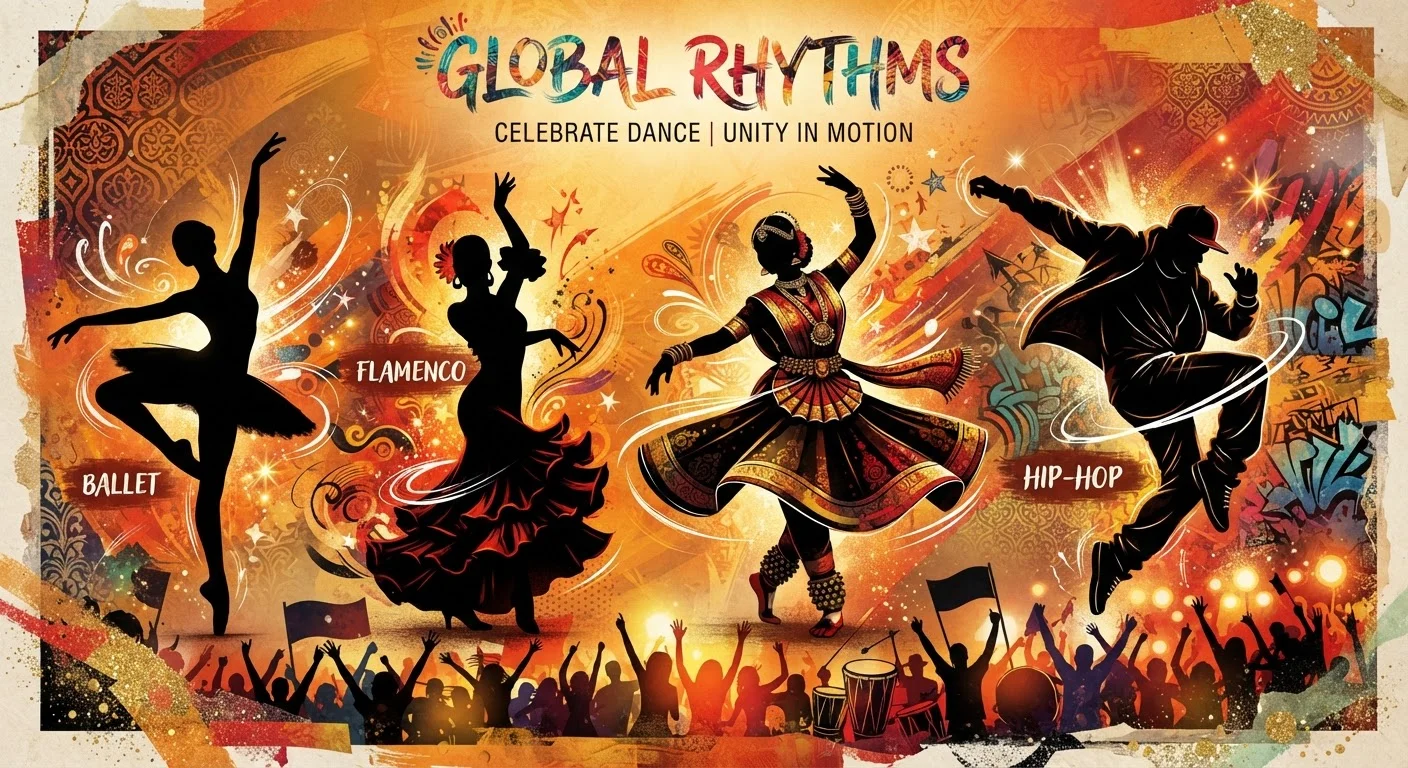
Photo credit: TrendingExperts.net
Ballet, Bharatanatyam, flamenco, hip-hop — dance takes radically different shapes across cultures. Explore what defines each tradition.
Key Takeaways
- Every major dance tradition reflects the history, values, and social structures of the culture that created it.
- Technical demands vary widely - ballet trains the body for lightness; flamenco channels raw emotional grounding.
- Many global dance forms carry spiritual or ceremonial meaning far beyond pure performance or entertainment.
- Hip-hop dance emerged from grassroots community expression and continues to evolve as a living cultural force.
- Understanding what makes each form distinct deepens appreciation when watching live or recorded performances.
Why Dance Looks So Different Across the World
Dance is one of humanity's oldest and most universal languages - yet the dialects couldn't be more different. A ballerina reaching toward the ceiling and a flamenco dancer driving her heels into the floor are both doing something called dance, but the intentions, techniques, histories, and emotional registers behind each are worlds apart.
Those differences aren't arbitrary. Every dance tradition grew out of specific conditions: the religious practices of a civilization, the social hierarchies of a royal court, the improvisational spirit of a neighborhood, or the seasonal rhythms of an agricultural community. Learning to read those differences transforms watching dance from passive viewing into genuine discovery.
Below are eight distinct dance forms from around the world - what each looks like, where it came from, and what gives it its unmistakable character.
Ballet
Originating in the Italian Renaissance courts of the 15th century and later formalized in France and Russia, ballet is built on an extremely precise vocabulary of positions, turns, and jumps. Its defining aesthetic is an illusion of effortlessness - dancers train for years to make gravity look optional.
The turned-out feet, elongated lines, and use of pointe shoes (for female dancers) are immediately recognizable. Structurally, classical ballet follows strict hierarchies and a shared technical language that allows dancers from Moscow, Paris, and New York to perform together with minimal adjustment. Major works like Swan Lake and The Nutcracker remain cultural touchstones worldwide.
Ballet's defining illusion is effortlessness - years of training make gravity look optional.
Bharatanatyam
One of the oldest classical dance forms in the world, Bharatanatyam originates from Tamil Nadu in South India and has roots in temple ritual dating back over two thousand years. It is distinguished by its precise hand gestures (mudras), expressive facial storytelling (abhinaya), and rhythmically complex footwork performed in synchrony with Carnatic music.
The dancer's body forms geometric angles - bent knees, sharp diagonal arms - that contrast deliberately with ballet's vertical aspirations. Each performance traditionally narrates scenes from Hindu mythology, making it simultaneously dance, drama, and devotional practice.
Bharatanatyam is simultaneously dance, drama, and centuries-old devotional practice.
Flamenco
Flamenco emerged in Andalusia, Spain, shaped by the cultural convergence of Romani, Moorish, Jewish, and Andalusian traditions. It is defined by its emotional intensity - duende, a kind of raw, soulful power - expressed through percussive footwork (zapateado), dramatic arm and hand movements, and the interplay between dancer, guitarist, and vocalist.
Unlike ballet's upward reach, flamenco grounds the dancer into the earth. The stamping heels aren't decoration; they are a form of musical percussion and emotional declaration. Flamenco was recognized by UNESCO as an Intangible Cultural Heritage of Humanity in 2010.
Flamenco's stamping heels are both musical percussion and emotional declaration.
Kathak
Kathak is a classical North Indian dance form whose name derives from the Sanskrit word for storyteller (katha). It developed through both Hindu temple traditions and the Mughal courts, which layered in Persian and Central Asian influences - making it one of the most historically layered dance forms in existence.
Kathak is famous for its rapid spins (chakkar) and intricate footwork patterns performed to rhythmic syllables called bols. The upper body remains fluid and expressive while the feet execute complex rhythmic calculations, often in dialogue with a tabla player.
Kathak blends Hindu temple storytelling with Mughal courtly elegance in every spin.
Hip-Hop Dance
Hip-hop dance was born in the 1970s in the South Bronx, New York, emerging alongside DJ culture, graffiti art, and rap as one of the four foundational elements of hip-hop culture. Breaking (often called breakdancing), locking, and popping were its earliest forms - each with distinct origins and communities.
What sets hip-hop dance apart is its improvisational DNA and its social function. Battles - competitive freestyle exchanges - remain central to the culture. The form is continuously evolving, absorbing new influences while debating the boundaries of authenticity. Breaking made its debut as an Olympic sport at the Paris 2024 Games, signaling just how far it has traveled from Bronx block parties.
Hip-hop dance's improvisational battles are as central to its identity as any specific move.
Hula
Hula is the traditional dance of Hawaiʻi, inseparable from Hawaiian language, oral history, and spiritual life. The older, more sacred form - hula kahiko - is performed to chant and traditional percussion, with movements that narrate stories of gods, nature, and ancestors. The more modern form, hula ʻauana, incorporates Western musical instruments and emerged after colonization reshaped Hawaiian culture.
Hula's characteristic hip swaying, fluid arm gestures, and hand movements each carry specific narrative meaning. Far from the simplified tourist-facing version many Americans know, traditional hula is a rigorous scholarly and artistic discipline preserved through dedicated schools called hālau hula.
Traditional hula is a rigorous scholarly discipline, not the simplified tourist version many know.
Tango
Tango developed in the late 19th century in the working-class neighborhoods of Buenos Aires, Argentina, and Montevideo, Uruguay - a synthesis of African rhythms, European immigrant music, and local Río de la Plata culture. It is a partnered dance defined by close embrace, improvisation within a shared framework, and an almost conversational negotiation between partners.
The characteristic tango walk, pauses, and leg embellishments (adornos) communicate through subtlety. Argentine tango - distinct from the theatrical stage tango most Americans recognize - prioritizes the private connection between two dancers over external performance. UNESCO recognized the tango as Intangible Cultural Heritage in 2009.
Argentine tango prioritizes the private connection between partners over external spectacle.
West African Dance
West African dance is not a single style but a diverse family of community and ceremonial traditions spanning countries including Ghana, Senegal, Guinea, and Mali. What these forms share is a deep integration of dance, drumming, and community participation - dance is rarely a spectator-only event but something the whole community joins.
Polyrhythm (multiple rhythmic patterns sounding simultaneously) drives the music, and the body responds with grounded, earthy movement that emphasizes the hips, torso, and feet. These traditions carry enormous historical weight: many movement patterns, rhythms, and call-and-response structures survived the Middle Passage and became roots of African American music and dance, including gospel, jazz, and hip-hop.
West African dance is never just performance - it is community participation, ceremony, and shared memory.
What Every Dance Form Has to Teach Us
Taken together, these traditions reveal something striking: dance is never just movement. It is memory, identity, belief, and community made visible in the body. Whether a form is codified in centuries-old treatises or continuously reinvented on concrete plazas, it carries meaning that words alone rarely can.
Watching any of these traditions with even a little context changes the experience entirely. The next time you encounter an unfamiliar dance style - on stage, on screen, or in a public space - consider what history might be moving through those gestures. You might find yourself far more moved than you expected.
Easy Ways to Explore Dance Traditions
Many regional arts councils and cultural centers offer free or low-cost dance performances throughout the year - it's worth checking your local listings. Streaming platforms and YouTube also host full-length performances by major dance companies worldwide, including archival footage of legendary artists. Seeking out live performances by community dance groups in your area is often the most immediate and authentic way to experience a tradition.

Author
Entertainment Editorial Team
Entertainment Editorial Team is the collective byline for our editorial team and contributor network. Articles published under this byline or an editorial pen name are researched, written, and reviewed according to our editorial standards for clarity, consistency, and independence before publication.
View all articles →